SEVENTY-SIXTH (76TH) INFANTRY REGIMENTOHIO VOLUNTEERS, OCTOBER 5TH, 1861, to JULY 15TH, 1865
The following historical information is about the service of both the regiment, and the men, of the Seventy-Sixth (76th) Ohio Volunteer Infantry Regiment, which served in the American Civil War from October 1861 to July 1865. If you have any corrections, suggestions, or additional information, photographs, artifacts, etc., that you wish to contribute, feel free to submit the information to the Webmaster.
 |
Did you find this website helpful?Would you like to support the Zouaves Archives?Visit our Store Front at theRIFLEMEN'S WORKSHOPAnd get yourself a shirtto show your Regimental Pride and Support for this site! |
 |
| Regimental Field & Staff |
| Company A |
Company F |
| Company B |
Company G |
| Company C |
Company H |
| Company D |
Company I |
| Company E |
Company K |
From Pages 439 to 443, Volume II, of "Ohio in the War. Her Statesman, Generals and Soldiers." By Whitelaw Reid, ca. 1895.
| Captain Charles R. Woods, of the Ninth United States Infantry, having been authorized to raise a regiment for the three-years service, recruited and organized the Seventy-Sixth Ohio Volunteer Infantry at Newark, Ohio, on the 9th of February 1862. The regiment left Newark, and, proceeding via Paducah, Kentucky, to Fort Donelson, took an active part in the engagement at that place. On the 6th of March it moved to the Tennessee River, and then up the river to Crump's Landing, where it remained until the 31st, when it marched to Adamsville, and took position in General Lew Wallace's division, in the right wing of General Grant's army. The division made a forced march to Pittsburg Landing on the 6th of April, and was in line of battle by dark, and during the entire engagement was constantly exposed to the enemy's fire. In the latter part of April the regiment formed a part of a reconnoitering party toward Corinth, charging the Rebels, driving them from their position, and destroying their camp equipage. It formed a part of the grand reserve during the advance on Corinth, and after the evacuation, moved to Memphis, arriving on the 17th of June, having marched one hundred and thirty miles with wagon supplies. The Seventy-Sixth moved down the river on the 24th of July, and encamped near Helena, Arkansas. |
 (Ohio State Archives) (Ohio State Archives) |
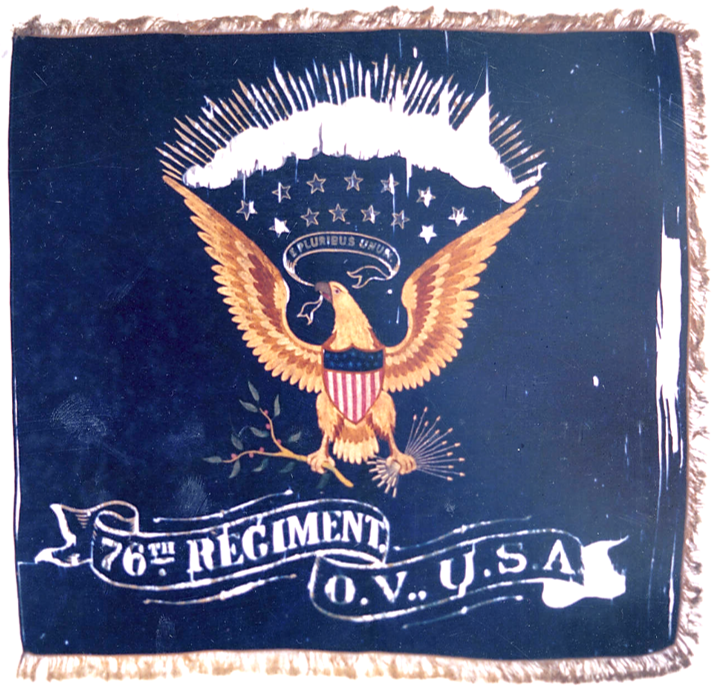 Ohio State Archives Ohio State Archives |
In the reorganization of the Army of the South-West the Seventy Sixth was placed in the Second Brigade, commanded by Colonel C.R. Woods, and in the Third Division, commanded by General Peter J. Osterhaus. On the 16th of August the regiment, forming a part of an expedition of observation, moved down the Mississippi, landed at Milliken's Bend on the 18th, surprised the Thirty-First Louisiana Regiment, and captured all its camp and garrison equipage. The enemy was followed nine miles, and forty prisoners were captured. The fleet dropped down to the mouth of the Yazoo, and a detachment, comprising a portion of the Seventy-Sixth, proceeded up the Yazoo, surprised Haines's Bluff, and captured four siege guns, two field pieces, and a large quantity of fixed ammunition. The expedition returned to Helena on the 27th. The regiment embarked for St. Genevieve, Missouri, early in October, and, remaining a week, moved with the division to Pilot Knob, where it encamped for rest and reorganization. It became very healthy and efficient during its stay here, and on the 12th of November returned to St. Genevieve and embarked for Camp Steele, Mississippi. On the 21st of December it formed a part of General Sherman's expedition for Vicksburg. The fleet arrived at Johnson's Landing, on the Yazoo, on the 26th, and the division, then commanded by General Steele, disembarked; and Hovey's brigade, of which the Seventy-Sixth was a part, made a feint on Haines's Bluff, and then took position on the extreme left of the army. On the 29th the division moved to the main army at Chickasaw Bayou; and during the battle, the regiment was held in reserve.
General Sherman having abandoned the assault on Vicksburg, the troops re-embarked and proceeded up the Mississippi, landing at Arkansas Post on the evening of the 10th of January 1863. That night the regiment marched six miles through mud and water, and by two o’clock next morning the troops occupied the cantonments of the enemy. Shortly after daylight they moved upon the enemy's works, and about one o’clock the Seventy Sixth charged within one hundred yards of the rifle pits, halted, opened fire, and held the position for three hours, when the enemy surrendered. On the 14th, after burning the cantonments of the enemy, it returned to the river, and embarking on the 23rd, the troops landed at Young's Point, Louisiana. On the night of the 14th of February two (2) non-commissioned officers of Company B were killed and four (4) disabled by lightning. During the entire month heavy details were made from the regiment to work upon the canal then in progress across the neck of land opposite Vicksburg. On the 2nd of April the regiment, with Steele's division, proceeded on transports up the river to Greenville, Mississippi. The command marched down Deer Creek after the Rebel force under Colonel Ferguson, and on the 7th made an attack and routed them. The command returned to Greenville after destroying a million dollars worth of corn and cotton, and bringing off a large number of cattle, horses and mules. About three hundred negroes followed the troops on their return, and were enlisted in colored regiments.
On the 24th the Seventy-Sixth returned to Young's Point, and on the 26th moved to Milliken's Bend, and prepared to march with the grand army southward. On the 2nd of May the Fifteenth Corps started for Hard Times Landing, where it arrived on the 6th, and crossed to Grand Gulf. The Seventy-Sixth moved eastward, and, at Fourteen Mile Creek, the division was attacked by a mounted force of the enemy. Colonel Woods's brigade pushed across the creek in the face of a sharp fire and drove the enemy back. At Jackson the regiment charged the works on the enemy's left. The works were evacuated and the city surrendered. On the 16th the corps marched for Vicksburg, and on the 18th took position in the line of investment. The next day the regiment pushed along the foot of the bluffs near the river, and established itself in position six hundred yards from the main lines of the enemy. The batteries of the enemy in front of the Seventy-Sixth were silenced, and none of his guns could be manned except those of the water batteries. Heavy details were constantly made for strengthening the works. In the course of several nights eight guns were taken off the sunken gunboat Cincinnati and placed in position with telling effect. After the surrender of Vicksburg the regiment marched in pursuit of Johnston, and arrived at Jackson on the 10th of July. While here it was chiefly employed in foraging and making reconnaissance’s. On the 23rd the regiment marched for Big Black Bridge, where the corps went into camp for rest and reorganization.
On the 23rd of September the division (General Osterhaus in command) embarked at Vicksburg for Memphis; and on the 30th moved from the latter place by railroad to Corinth. During the months of October and November the regiment marched and skirmished in Northern Alabama and Tennessee; arriving at Chattanooga in time to join General Hooker in the assault on Lookout Mountain; was engaged at Mission Ridge; and on the 27th of November charged up Taylor's Ridge under a heavy fire, suffering a fearful loss. In one company of twenty (20) men eight (8) were killed and eight (8) wounded, and seven (7) men were shot down while carrying the regimental colors. After marching and bivouacking in various places, on the 1st of January 1864, the regiment went into camp for the winter at Paint Rock, Alabama.
On the 4th of January about two thirds of the regiment re-enlisted as veterans, and leave was granted to proceed to Ohio. On the 30th it moved, via Nashville, Louisville and Cincinnati, to Columbus, Ohio, and on the 8th of February took the train for Newark. The regiment disembarked one mile from the city, and moved into town in column by company. It was enthusiastically welcomed by a large concourse of the citizens; speeches were made and a sumptuous repast was partaken of at the City Hall. The members were furloughed to their homes. The Seventy-Sixth went away nine hundred and sixty two (962) strong, and returned in two years with less than three hundred. The regiment returned to Cincinnati on the 15th of March, and proceeded, via Louisville, Nashville and Huntsville, to the old camp at Paint Rock. On the 1st of May it broke camp and marched with the division for Chattanooga. At Bridgeport it was presented with a new stand of colors from the citizens of Newark. The troops arrived at Chattanooga on the 6th, and pushed forward twelve miles. On the 9th the regiment moved through Snake Creek Gap, and continued moving forward, skirmishing and fortifying, until the 14th, at six o’clock in the evening, when the regiment, with the brigade, charged across the fields under a hot fire, and gained a footing on the first line of hills west of Resaca. On the 16th, the enemy having evacuated, the Seventy-Sixth moved through Resaca and Adairsville to Dallas. Hardee's corps assaulted the lines of the Fifteenth Corps on the 28th, and was repulsed, leaving many dead on the field, some of them within fifty yards of the works in front of the Seventy-Sixth Ohio.
On the 1st of June the corps moved to the left, near New Hope Church, then to Acworth, then south, and so on, each day advancing and fortifying, until on the 22nd, it occupied a position near the railroad at the foot of Kennesaw Mountain. The regiment remained in the rifle pits until after the Rebels evacuated it; then moved to Rossville; thence across the Chattahoochie, through Decatur, to within four miles of Atlanta, on the 20th of July. On the 22nd the Rebels captured four twenty-pound Parrott guns, and the Seventy-Sixth Ohio and the Thirtieth Iowa, of the First Brigade, were the first to drive the enemy from the works and to recapture the guns. About noon on the 28th the enemy attacked the whole line of the Fifteenth Corps; and three successive charges being made, each one proved unavailing. One thousand of the Rebel dead were found in front of the Fifteenth Corps. On the 13th of August the skirmish line in front of the division was advanced, and the Seventy-Sixth captured fifty (50) prisoners. On the 26th the regiment moved out of the works, with the division, to the West Point and Montgomery Railroad, which they destroyed, marched southward toward Jonesboro; and on the night of the 30th formed in line across Flint River. The next day the Rebels charged the line and were repulsed, the Seventy-Sixth taking an active share in the engagement, without the protection of rifle pits.
On the 8th of September the division moved to East Point and encamped for rest and reorganization. On the 4th of October the regiment crossed the Chattahoochie, marched through Marietta, north of Kennesaw Mountain, near Adairsville; through Resaca; through Snake Creek Gap; and on the 16th skirmished with the enemy at Ship's Gap. On the next day the regiment marched through Lafayette, and on the 18th moved south through Summerville and bivouacked. Here the non-veterans were mustered out. The regiment moved with the army to Little River, Cave Springs, and near to Atlanta. On the 15th of November the Fifteenth Corps cut loose from Atlanta and moved southward with the right wing of the army, averaging fifteen miles per day, and foraging off the country.
The route of the Fifteenth Corps was via McDonough, Indian Springs, Clinton, and Irwintown, crossing the Macon and Augusta Railroad twenty miles east of Macon; thence eastward across the Oconee River to the Ogeechee, and down the west bank of that stream to the month of the Cannouchee; thence across the Ogeechee eastward to Savannah, where it formed on the 18th of December, being twenty-six days out from Atlanta.
After the evacuation the regiment performed provost-guard duty in the city until the 9th of January 1865, when it embarked on the gunboat Winona for Beaufort, South Carolina. From Beaufort it marched to Gardner's Corners, where preparations were made for the march northward; and on the 31st the command broke camp and started on the Campaign of the Carolinas. On the 16th of February the troops formed on the outskirts of Columbia, and the Seventy-Sixth was engaged in skirmishing until the evacuation of the city, when it again performed provost-guard duty for four days. The troops arrived at Fayetteville on the 12th of March crossed Cape Fear and Black Rivers; moved to Bentonville, where they engaged the enemy; and thence via Goldsboro to Raleigh, where the Seventy Sixth remained until Johnston's surrender.
On the 30th of April the army broke camp and marched, via Richmond and Hanover Courthouse, to Washington, reaching the capital on the 23d of May 1865. The Seventy-Sixth shared in the grand review, and shortly after moved to Louisville, Kentucky, where it was mustered out. It then proceeded to Columbus, Ohio, and was discharged on the 24th of July 1865.
This regiment participated in forty-four battles; moved nine thousand six hundred and twenty five miles on foot, by rail, and by water; passed through the rebellious States of Kentucky, Missouri, Arkansas, Tennessee, Louisiana, Mississippi, Alabama, Georgia, South Carolina, North Carolina and Virginia. Two hundred and forty-one (241) men were wounded in battle; three hundred and fifty one (351) died on the field or in hospitals; two hundred and twenty two (222) carry scars as evidence of their struggle with the enemy, and two hundred and eighty two (282) have the seeds of disease contracted in the line of duty. It is a sad, but noble record, and the survivors may well be proud of the part they have taken in establishing the greatness and permanence of the American Union.
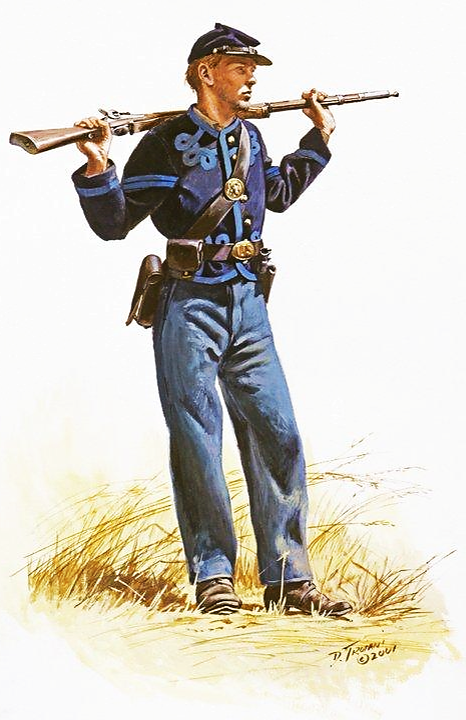 Artist Rendition(Don Troiani) Artist Rendition(Don Troiani) |
Additional Research on the Uniform of the 76th Ohio Volunteer Infantry Regiment is pending. If you have any additional information that you wish to contribute, feel free to submit it to the Webmaster. |
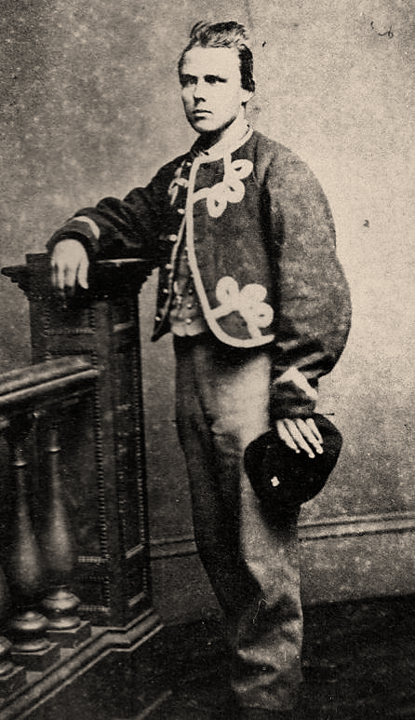 Lee Mathews, Company D("Zouaves, the First and the Bravest.") Lee Mathews, Company D("Zouaves, the First and the Bravest.") |
PUBLISHED MATERIAL
Page 1532, "A Compendium of the War of the Rebellion." Frederick H. Dyer, The Dyer Publishing Company, Des Moines, Iowa, 1908.
Volume I, "Historical Register and Dictionary of the United States Army, from its organization, September 29, 1789, to March 2, 1903." Francis B. Heitman, Government Printing Office, Washington, D.C., 1903.
Pages 171 & 172, Part V, "Official Army Register of the Volunteer force of the United States Army for the years 1861, '62, '63, '64, '65." Adjutant Generals Office, United States Army, 1865 to 1867.
Pages 256 to 296 and 735 to 742, Volume VI (70th-86th Regiments-Infantry), "Official Roster of the Soldiers of the State of Ohio in the War of the Rebellion, 1861-1866. The Werner Printing and Manufacturing Company, Akron, Ohio; 1887.
Pages 439 to 443, Volume II, "Ohio in the War. Her Statesman, Generals and Soldiers." Whitelaw Reid; The Robert Clarke Company, Cincinnati, Ohio; 1895.
"Reminiscences of a Boy's Service With the 76th Ohio in the Fifteenth Army Corps, Under General Sherman, During the Civil War, by that "Boy" at Three Score." Charles A. Willison; The George Banta Publishing Company, Menasha, Wisconsin; 1908.
"The Struggle for the Life of the Republic: A Civil War Narrative by Brevet Major Charles Dana Miller, 76th Ohio Volunteer Infantry." Charles D. Miller & edited by Stewart Bennett and Barbara Tillery; The Kent State University Press; Kent, Ohio; 2004.
"The Temple of Fame. A Personal Biography of Lyman Underwood Humphrey." Paul F. Harper; The Mennonite Press, Newton, Kansas; 1995.
"War Songs, Poems and Odes." Richard W. Burt; J.W. Franks & Sons; Peoria, Illinos; 1906.
DOCUMENTS, PAPERS & NON-PUBLISHED MATERIALS
Letters of William G. Baugh 1864-1865. (Company I). Emory University, Atlanta, Georgia.
John F. Brown Letters (Company A). Earl Hess Collection, United States Army Military Heritage Institute, Carlisle Barracks, Pennsylvania.
Captain Richard W. Burt Papers. Western Historical Manuscript Collection, University of Missouri, Columbia, Missouri.
Compiled Records Showing Service of Military Units in Volunteer Union Organization. Roll 180 - Pennsylvania, One Hundred Tenth Infantry through One Hundred Twenty-First Infantry. National Archives & Records Administration, Washington, D.C.
Strew M. Emmons Letters, 1862-1863 (Company F). Collection and Papers of John Page Nicholson, Huntington Library, San Marino, California.
Lyman Underwood Humphrey Papers, 1834-1944. Kansas State Historical Society, Topeka, Kansas.
David Merwin Letters (Company I). Massillon Museum, Massillon, Ohio.
John J. Metzgar Letters (Company C). Ohio Historical Society, Columbus, Ohio.
John J. Metzgar Papers 1862-1918 (Company C). Southern Historical Collection, University of North Carolina, Chapel Hill, North Carolina.
Pension applications for service in the US Army between 1861 and 1900, grouped according to the units in which the veterans served. (NARA T289) National Archives & Records Administration, Washington, D.C.
Franklin A. Wise Diaries (Company I). Western Reserve Historical Society Archives Library, Cleveland, Ohio.
PHOTOGRAPHS, IMAGES & ARTIFACTS
Library of Congress Washington, District of Columbia.
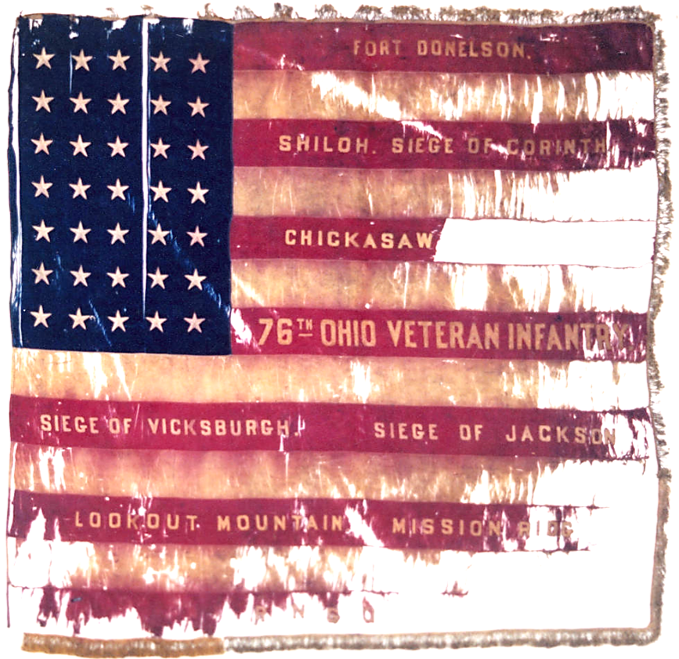
National Colors; Ohio Battle Flag Audiovisual Collection.
1st Regimental Colors; Ohio Battle Flag Audiovisual Collection.
2nd Regimental Colors; Ohio Battle Flag Audiovisual Collection.
United States Army Heritage & Education Center. Carlisle, Pennsylvania.
WEBSITES & ONLINE RESOURCES
76th Ohio Infantry.
Reluctant Yanks. The Civil War Letters of Joseph F. & B. Franklin Orr. (Company F)
|