THIRTY-FOURTH (34TH) OHIO INFANTRY REGIMENT1ST REGIMENT OF ZOUAVES / PIATT'S ZOUAVES - JULY 27TH, 1861, to FEBRUARY 22ND, 1865
The following historical information is about the service of both the regiment, and the men, of the "1st Regiment of Zouaves / Piatt's Zouaves" - Thirty-Fourth (34th) Ohio Volunteer Infantry Regiment, which served in the American Civil War from July 1861 to February 1865. If you have any corrections, suggestions, or additional information, photographs, artifacts, etc., that you wish to contribute, feel free to submit the information to the Webmaster.
 |
Did you find this website helpful?Would you like to support the Zouaves Archives?Visit our Store Front at theRIFLEMEN'S WORKSHOPAnd get yourself a shirtto show your Regimental Pride and Support for this site! |
 |
| Regimental Field & Staff |
| Company A |
Company F |
| Company B |
Company G |
| Company C |
Company H |
| Company D |
Company I |
| Company E |
Company K |
From Pages 221 to 227, Volume II, of "Ohio in the War. Her Statesman, Generals and Soldiers." By Whitelaw Reid, ca. 1895.
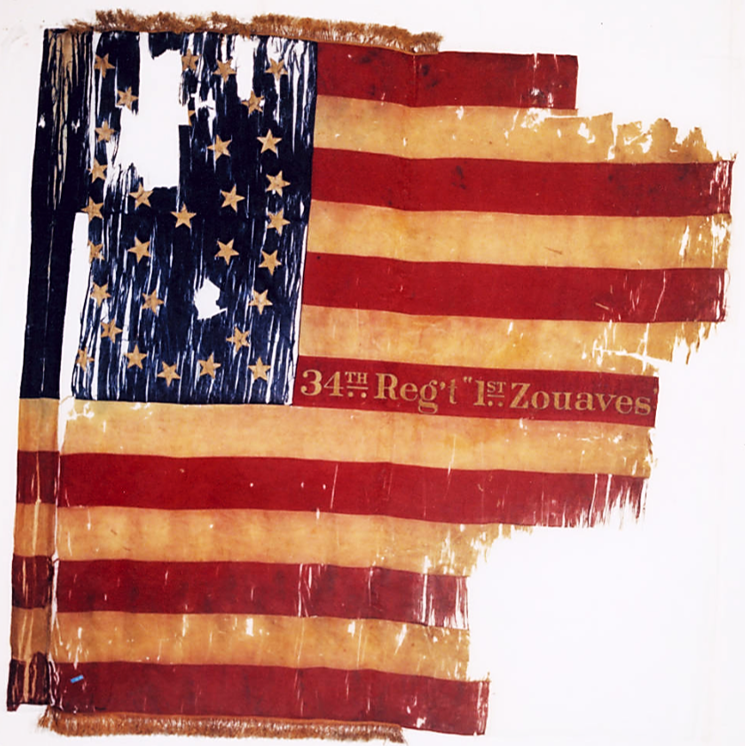 (Ohio State Archives) (Ohio State Archives)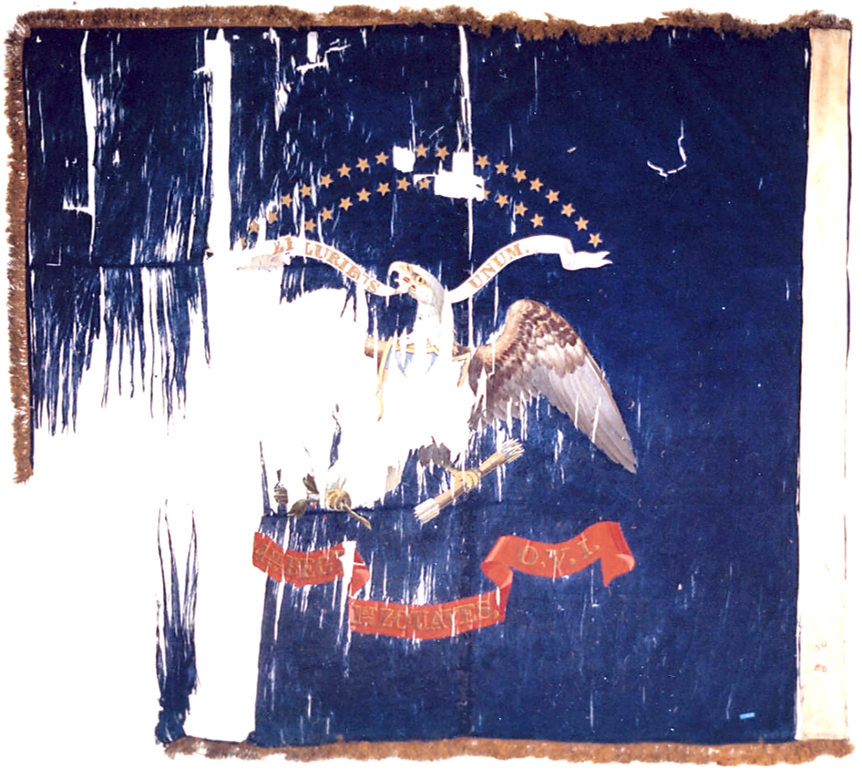 Ohio State Archives Ohio State Archives |
This regiment was organized at Camp Lucas, Clermont County, Ohio, during the months of July and August 1861; the first detachment entering camp July 15th, and the first regular companies, under Captains Broadwell and Evans, July 21st. On the morning of September 1st it moved to Camp Dennison, and was there prepared for the field, adopting as its uniform (a license allowable at that early period of the war) a light blue Zouave dress. In compliment to their Colonel, the name of "Piatt Zouaves" was adopted.
The regiment left Camp Dennison on the 15th of September 1861, for Western Virginia, with full ranks, and arrived at Camp Enyart, on the Kanawha River, on the 20th of the same month. On the 25th it fought its first battle in a gap near Chapmanville, Logan County, Virginia, whipping a Virginia regiment, inflicting considerable loss to the Rebels in men, and badly wounding their commander, Colonel Davis. The loss of the Thirty-Fourth was one (1) killed and eight (8) wounded. During the remainder of the autumn and winter the regiment was engaged in the arduous duty of guarding the rear of General Rosecrans's army, and the counties of Cabell, Putnam, Mason, Wayne, and Logan were kept pretty free from guerillas by continual scouting.
In March 1862, the Thirty-Fourth was ordered to Gauley Bridge to join General Cox in his demonstration on the Virginia and Tennessee Railroad. The regiment participated in the battle of Princeton, on the 17th and 18th of May, losing several men. Lieutenants Peck and Peters were wounded, and Captain O.P. Evans taken prisoner. Humphrey Marshall commanded the Rebels.
When General Cox was ordered to join General McClellan, in August 1862, there were six regiments left to guard the Kanawha Valley. The Thirty-Fourth and Thirty-Seventh held the outpost at Fayetteville, where, on the morning of September 10th, they were attacked by a Rebel force, under Major General William W. Loring, ten thousand strong. With the aid of admirable breastworks, previously constructed by General Scammon, two ten-pound brass field pieces and four six-pound mountain howitzers, the position was held until midnight, when the place was evacuated. Part of the time the Thirty-Fourth fought in the open field, and repeatedly charged on the enemy. Its loss was necessarily heavy. Of six companies engaged (the other four, under Major Franklin, being on a scout) the loss was one hundred and thirty (130), or fully one-third. One-half of the officers were either killed or wounded. Cutting their way out under a heavy fire, the National troops fell back towards the Kanawha river, made a stand at Cotton Mountain the next day, and at Charleston on the 12th, where a severe engagement took place. From this point the entire National force fell back to Point Pleasant, leaving the entire valley in the hands of the Rebels. In October General Cox returned with his command, when another advance was made, and the valley regained.
From this time until May 1863, nothing of moment occurred to vary the monotony of garrison duty. During May the regiment was furnished with horses and transformed into "Mounted Rifles."
|
On the 13th of July 1863, an expedition, consisting of the Thirty-Fourth, two companies of the First, and seven companies of the Second Virginia Cavalry, under command of Colonel Toland, made a demonstration on the Virginia and Tennessee Railroad, striking it, on the evening of the 18th, at Wytheville. A desperate fight ensued, the enemy occupying the houses, barns, yards, etc., on a slight elevation to the rear of the town. About dark the National forces succeeded in capturing the enemy's artillery, and driving him in all directions. Captain Delany, commanding First Virginia, was killed, and Colonel Powell, Second Virginia, badly wounded. The Thirty-Fourth Ohio lost four (4) killed, including Colonel Toland, thirteen (13) wounded and thirty-three (33) missing. (Colonel Toland was shot from a window of a house in his immediate vicinity, while seated on his horse, engaged in giving orders, surrounded by a few of his staff. The ball passed through his left breast. The Colonel did not fall from his horse, but caught the mane with his right hand, when his Orderly, who was about fifty yards distant from him, ran and caught him before he had time to reach the ground. With his last breath he requested that his horse and sword be sent to his mother.)
The brigade left Camp Piatt with nearly one thousand men; marched six hundred and fifty-two miles in eleven days, traversing some of the highest mountains in West Virginia, capturing over two hundred and fifty horses and three hundred and sixty prisoners, two pieces of artillery, and a large amount of commissary stores; destroyed between three and five thousand stand of arms, a bridge of importance, and partially burned one of the wealthiest cities in Virginia.
Upon the fall of Colonel Toland, the command devolved upon Lieutenant Colonel Franklin, who decided on a retrograde movement. This he found it difficult to execute, from the fact that the Rebel General John S. McCausland had blockaded the roads in the most effectual manner. For several days the command was moving in the mountains, destitute of food for themselves or fodder for their horses, and continually harassed by Rebel cavalry. On the day previous to the arrival of the regiment at Wytheville, Company C, acting as rear guard, was attacked by a superior force of Rebel cavalry. A number was killed and wounded, and Captain Cutter and fifteen (15) men were taken prisoners.
Several expeditions under General Duffie (who had assumed command of the Kanawha cavalry) to Lewisburg and vicinity, completed this year's campaign.
In January 1864, about two thirds of the regiment re enlisted as veterans. On the 29th of April 1864, the regiment was divided in two detachments. The mounted portion was to operate with the cavalry, under General Averill; the dismounted, with the Thirty-Sixth Ohio Volunteer Infantry, in General Crook's division of infantry.
On the 1st of May 1864, the second expedition for the destruction of the Virginia and Tennessee Railroad left Charleston. On the 9th the cavalry arrived at Wytheville, encountered the Rebels under General Morgan, were repulsed, and compelled to fall back, with considerable loss. The infantry, under General Crook, was more successful. On the same day that Averill was defeated, Crook achieved a solid victory over General Jenkins at Cloyd Mountain, near Dublin Depot, which was captured the same evening. On the day following the enemy was again encountered and defeated at the railroad bridge over New River, and the bridge totally destroyed. From this point the command returned to Meadow Bluffs, crossing Salt Pond and Peter's Mountains and the Greenbrier River, arriving at their destination on the 19th of May, completing a distance of four hundred miles marched during the month.
From Meadow Bluffs the Thirty-Fourth started to join General Hunter, at Staunton, in the Shenandoah Valley, passing through White Sulphur Springs, Callahan's Stand, and crossing Panther Gap Mountain, where a skirmish ensued. On the 5th of June the regiment reached Goshen, on the Virginia Central Railroad, and skirmished with a body of cavalry at Cow Pasture River. The day after the Rebels were met at Buffalo Gap, in a position secure from direct attack, but General Hayes's brigade succeeded in flanking and driving them out of it.
Staunton was reached on the 8th of June, where the Thirty-Fourth made its final preparations to join General Hunter on his disastrous raid to Lynchburg. General Hunter, now reinforced by Generals Crook, Averill and Duffie, left Staunton on the 9th, and, passing through Brownsburg, reached Lexington on the 11th. The evening of the 14th found the regiment at Buckhannon, on the James River, at which point a few shots were exchanged with a small Rebel force that had been driven out of Lexington. Crossing the Blue Ridge, near the Peaks of Otter, the town of Liberty was reached on the 16th, when another skirmish occurred. From this point General Crook's command, with whom the dismounted members of the Thirty-Fourth were serving, was sent on a flanking expedition across the James, for the purpose of attacking Lynchburg in the rear, the cavalry, on the left, to make a diversion in their favor. The attack was made late in the afternoon of the 18th of June, was partly successful, and, in the opinion of the Thirty-Fourth, would have been entirely so had General Crook been allowed to occupy the city that night, according to his wish, but orders from his superior officer forbade it. The enemy were reinforced that night by about twenty thousand men from the vicinity of Richmond, under the command of General Early, which, of course, so strengthened the city that it was impossible, with the small and illy-appointed force under General Hunter, to cope with the Rebels.
The situation was fully developed early the next morning by a fierce cannonade from the Rebels, which was promptly replied to by the National forces. In the afternoon an engagement occurred, in which the Thirty-Fourth suffered severely. The retreat of the National forces commenced at dark on the 19th of June. The rear being heavily pressed by the pursuing enemy, the second skirmish occurred at Liberty. At Salem, on the 21st, while the artillery of Hunter's command was passing through a narrow defile, totally unsupported, a party of Rebels made a sudden descent from the hills, and, dispersing the drivers and gunners, commenced the work of destruction by shooting horses, cutting spokes and harness, and blowing up caissons. The mounted portion of the Thirty-Fourth, being a few miles in the rear, hurried to the scene of action, dismounted,, and with Lieutenant Colonel Shaw as their leader, encountered the Rebels. After a sharp fight the Rebels were driven off and the artillery regained.
The retreat was continued. Big and Little Sewell Mountains were crossed, and Charleston reached on the 1st of July, where the exhausted, ragged, and starved troops were permitted to rest. Thus ended this most disastrous expedition. The constant skirmishing, the starved bodies, and blistered feet of those who participated in it, made Hunter's retreat from Lynchburg an event long to be remembered.
The Thirty-Fourth lay at Charleston on the 10th of July, when it embarked on transports for Parkersburg. (A day or two previous to this move the whole regiment was dismounted rind horses and equipments turned over to the cavalry.) From Parkersburg the regiment moved by rail to Martinsburg, arriving there on the 14th of July 1864.
The regiment was now in the Shenandoah Valley. On the 20th of July, while General Crook, with his main force and the Sixth and Nineteenth Corps, was pressing Early back on Winchester, General Duval's brigade, of which the Thirty-Fourth was a part, attempted to occupy the place in advance of the Rebels, by a forced march from Martinsburg. Early, anticipating the movement, had sent forward his old division, under Major General Stephen D. Ramseur, to check it. The National force, only twelve hundred strong, met and attacked the Rebels two miles from Winchester, completely routing them, capturing their artillery, and killing and wounding all their brigade commanders. The loss of the Thirty Fourth was ten (10) killed and twenty (20) wounded. Four days later occurred the fourth battle of Winchester, in which General Early, taking advantage of the absence of the Sixth and Nineteenth Corps, overwhelmed General Crook – the latter, however, effecting an orderly retreat, with the loss of only a few wagons. In this battle General Duval's brigade had the honor of bringing up the rear, and the Thirty-Fourth suffered severely, losing their commander, Lieutenant Colonel Shaw, a cool, determined soldier, and Christian. He was struck in the abdomen by a musket ball, and was borne from the field by a few faithful men of his regiment, placed in an ambulance, and carried eleven miles distant, to a place called Bunker Hill, where he died. His last words were, "Welcome, welcome death!" Captain G.W. McKay was wounded about the same time in the leg, and would have fallen into the hands of the enemy but for the heroic devotion of some of his men, who carried him on a litter fifteen miles to Sandy Hook, Maryland, where he died.
The command of the regiment devolved upon Captain S.R.S. West, who fully sustained his reputation as a brave and gallant officer. The next day, July 25th, another stand was made at Martinsburg, the Thirty-Fourth being the last regiment to leave the field, which it did under a galling fire.
The time of the regiment between the 25th of July and the 3rd of September was occupied as follows: July 26th, forded the Potomac at Williamsport; 27th, marched to Sandy Hook, Maryland, opposite Harper's Ferry; 28th, crossed the Potomac at Halltown; 30th, re-crossed to Sandy Hook; 31st, marched through Middletown toward Pennsylvania State line; August 1st, continued the march to Wolfville, Maryland; 3rd, returned by same road to Frederick City, Maryland, and encamped on the Monocacy; 6th, returned to Harper's Ferry; 8th, re-crossed the Potomac and moved in the direction of Halltown; 10th, reached Berryville, Virginia; 11th, marched in line of battle in the direction of Front Royal – heavy skirmishing with Early, who was falling back on Fisher's Hill; 12th, reached Cedar Creek, found the enemy had burned the bridge, and was intrenched on the south bank of the stream. The Thirty-Fourth lay here until the evening of the 17th (skirmishing heavily in the meantime). It then fell back, marching all night, passing through Winchester, and camping at Berryville early next morning. The 20th of August found the Thirty-Fourth at Charlestown, with the enemy close in its rear. In the expectation of an attack. breastworks were thrown up; but after waiting in vain until ten o clock at night, the regiment fell back to Halltown. The enemy still followed, and, taking a position in the immediate front of the regiment, heavy skirmishing ensued until the 27th, when they withdrew to demonstrate on the upper Potomac. On the day following the Thirty-Fourth again occupied Charlestown, where the regimental officers were busily engaged making up the necessary papers for the discharge of the non-veterans, who, on the morning of the 3rd of September, proceeded to Columbus, Ohio, in charge of Captain West.
During the few months previous to this time the Thirty-Fourth had been largely reinforced by new recruits. Counting the veterans and the men of 1862, it still numbered between four and five hundred men, present and absent. (On the evening of the day on which the non-veterans left, the regiment participated in the battle of Berryville. The non-veterans were near enough to hear the booming of cannon.)
The enemy fell back to Winchester and Bunker Hill. The Thirty-Fourth marched to Summit Point, and lay in camp until the morning of the 19th of September, the day on which occurred Sheridan's famous battle of Winchester, it being the third time the regiment had fought over nearly the same ground. It suffered terribly that day, the color-guard having no less than six (6) men, in quick succession, killed and wounded while carrying the flag. It was finally brought through safe by George Rynals, of Company A. All know the result of that glorious battle, and remember Sheridan's celebrated dispatch, commencing: "I am moving up the Valley tonight." In accordance with this announcement, the next evening found the regiment at Cedar Creek, where it lay until the 22nd, when occurred the battle of Fisher's Hill. Here again, by the excellent management of General George Crook, the enemy was successfully flanked, which resulted in his total rout and the capture of all his artillery. The loss of the Thirty-Fourth in the last two engagements was sixty-one (61) killed.
The National forces followed the retreating and demoralized enemy to Harrisonburg, where they lay until the 6th of October. In the meantime the cavalry were busily engaged in burning barns filled with grain, driving in stock of all kinds, and otherwise rendering the Valley untenable as a base of supplies, and literally fulfilling Grant's order to Sheridan, to render it so desolate and provision-less that "a crow, in passing over it, would be compelled to carry his rations with him." By the 6th the work of devastation was completed, and the National army again fell back to Cedar Creek; while the enemy, following at a respectful distance, once more resumed his old position at Fisher's Hill.
Of General Early's desperate attempt to regain his lost laurels on the 19th of October, and of his partial success on the morning of "Sheridan's Ride" to the scene of action, and the irretrievable disaster of the Rebels in the afternoon, much has been said and sung. The brunt of the morning's surprise and attack fell on the left flank, composed of General Crook's corps, which, with the Nineteenth Corps occupying the center of the line, was badly shattered. The Sixth Corps, on the right, had time to fall back in good order. The troops were rallied near Middletown from whence the final advance was made, which swept everything before it. It is sufficient to say that the day was won.
The evening before the battle the regiment, under command of Lieutenant Colonel L. Furney, was sent on picket. In the morning, before dawn, when the surprise occurred, the Colonel and eighteen (18) of his men were taken prisoners. The Colonel escaped at Mount Jackson. and joined his command a few days thereafter. The loss of the Thirty-Fourth in this affair was two (2) killed, twelve (12) wounded and eighteen (18) prisoners. From this time until the latter part of December 1864, the regiment lay in the neighborhood of Kernstown, when it marched to Opequan Crossing, and from thence to Martinsburg.
On the evening of the 22nd of December, as the regiment was leaving Martinsburg, on its way to Webster, by rail, the train on which it was being transported came in collision with one loaded with coal, killing two (2) men and wounding fourteen (14). It reached Webster on the 25th and Beverly on the 28th.
On the 11th of January 1865, the post of Beverly, garrisoned by the Thirty-Fourth, which, by this time, was reduced to three hundred men present for duty, and the dismounted portion of the Eighth Ohio Cavalry, was attacked by the enemy, under command of Major General Thomas Lafayette Rosser. So secret and sudden was the attack – no alarm whatever being given until the enemy were in the quarters – that resistance was out of the question, and nearly every man was at one time a prisoner, though subsequently a great many escaped, favored by the darkness and intense excitement of the occasion. Colonel Youart, of the Eighth, commanding post, and Colonel Furney, were both captured, but afterward escaped. The survivors of this most unfortunate and disgraceful affair fell back to Philippi, and from thence were ordered to Cumberland, Maryland, where they were consolidated with the Thirty-Sixth Ohio, commanded by Colonel H.F. Duval. The union of the separate organizations dates from the 22nd of February 1865, in which the old Thirty-Fourth loses its identity – the coalition being known as the Thirty-Sixth Ohio Veteran Volunteer Infantry.
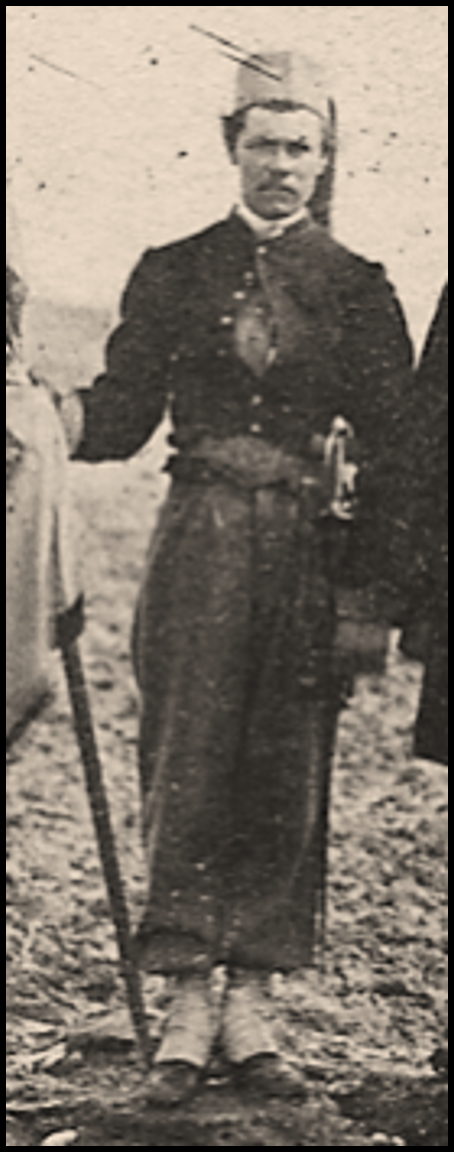 Regimental Color Bearer(Greene County Historical Society) Regimental Color Bearer(Greene County Historical Society) |
Additional Research on the Uniform of the Piatt Zouaves is pending.
Upon its organization the regiment adopted as its uniform a short dark blue jacket trimmed with red tape around the collar, cuffs and outer edges; sky blue trousers trimmed with a double row of red stripes running down the length of the legs; a set of leather leggings and a red fez with a blue tassel.
The fez was worn in the Ottoman, rather than French fashion, being worn erect rather than resting on the back of the head.
|
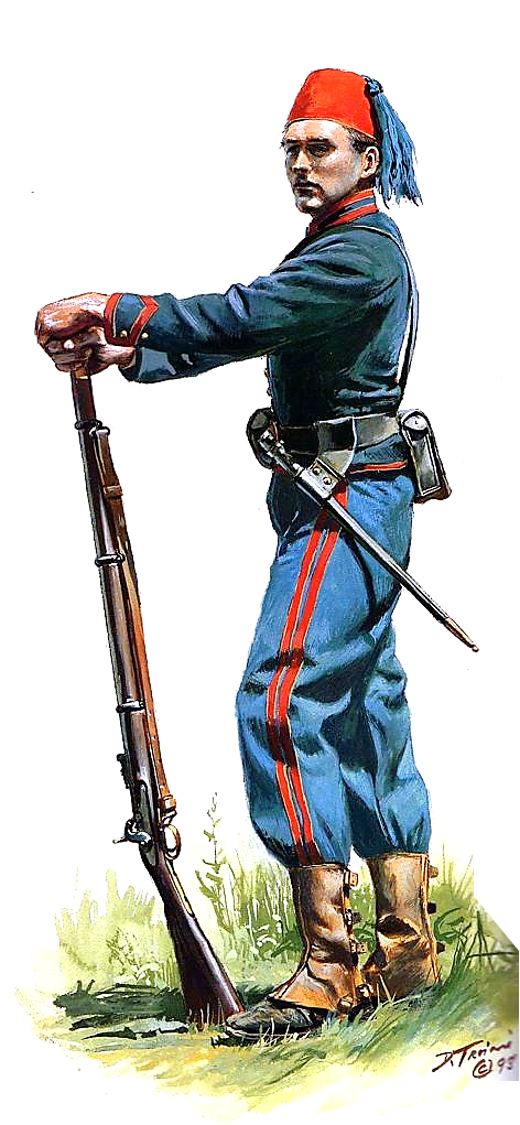 Artist's Rendition(Don Troiani) Artist's Rendition(Don Troiani) |
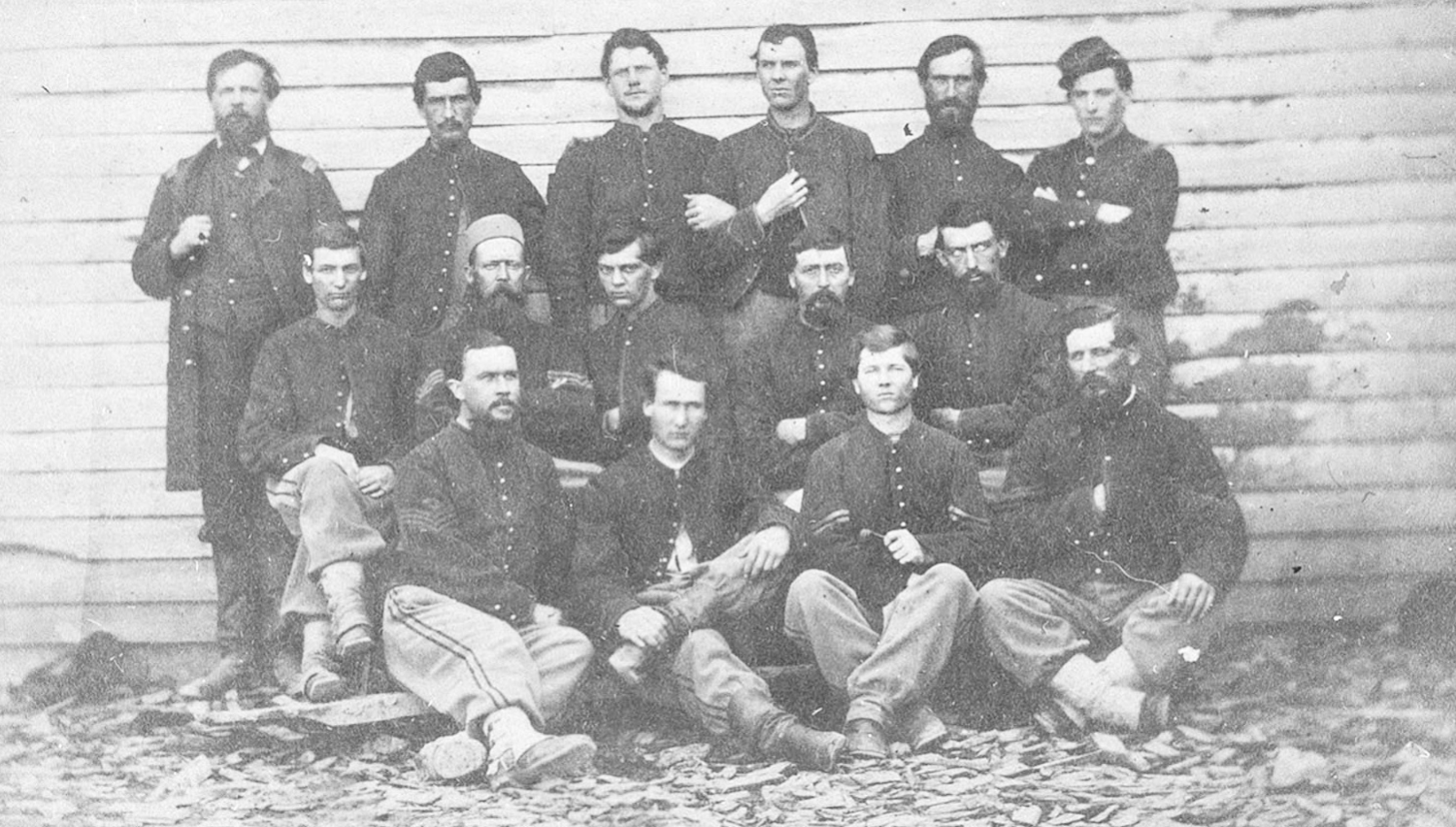 Group of Officers and Men of the 34th Ohio Volunteer Infantry Regiment
PUBLISHED MATERIAL
Pages 1512 & 1516, "A Compendium of the War of the Rebellion." Frederick H. Dyer, The Dyer Publishing Company, Des Moines, Iowa, 1908.
Volume I, "Historical Register and Dictionary of the United States Army, from its organization, September 29, 1789, to March 2, 1903." Francis B. Heitman, Government Printing Office, Washington, D.C., 1903.
Pages 105 & 106, Part V, "Official Army Register of the Volunteer force of the United States Army for the years 1861, '62, '63, '64, '65." Adjutant Generals Office, United States Army, 1865 to 1867.
Pages 554 to 598 and 768 to 771, Volume III (21st-36th Regiments-Infantry), "Official Roster of the Soldiers of the State of Ohio in the War of the Rebellion, 1861-1866." The Werner Printing and Manufacturing Company, Akron, Ohio; 1887.
Pages 221 to 227, Volume II, "Ohio in the War. Her Statesman, Generals and Soldiers." Whitelaw Reid; The Robert Clarke Company, Cincinnati, Ohio; 1895.
Group of Officers and Men of the 34th Ohio Volunteer Infantry Regiment
PUBLISHED MATERIAL
Pages 1512 & 1516, "A Compendium of the War of the Rebellion." Frederick H. Dyer, The Dyer Publishing Company, Des Moines, Iowa, 1908.
Volume I, "Historical Register and Dictionary of the United States Army, from its organization, September 29, 1789, to March 2, 1903." Francis B. Heitman, Government Printing Office, Washington, D.C., 1903.
Pages 105 & 106, Part V, "Official Army Register of the Volunteer force of the United States Army for the years 1861, '62, '63, '64, '65." Adjutant Generals Office, United States Army, 1865 to 1867.
Pages 554 to 598 and 768 to 771, Volume III (21st-36th Regiments-Infantry), "Official Roster of the Soldiers of the State of Ohio in the War of the Rebellion, 1861-1866." The Werner Printing and Manufacturing Company, Akron, Ohio; 1887.
Pages 221 to 227, Volume II, "Ohio in the War. Her Statesman, Generals and Soldiers." Whitelaw Reid; The Robert Clarke Company, Cincinnati, Ohio; 1895.
DOCUMENTS, PAPERS & NON-PUBLISHED MATERIALS
Peter Calhoun Papers. Ohio Historical Society, Columbus, Ohio. (Peter Calhoun, Company E)
Compiled Records Showing Service of Military Units in Volunteer Union Organization. Roll 180 - Pennsylvania, One Hundred Tenth Infantry through One Hundred Twenty-First Infantry. National Archives & Records Administration, Washington, D.C.
Luther Furney Diary 1863. Ohio Historical Society, Columbus, Ohio. (Captain Luther Furney, Company D)
Pension applications for service in the US Army between 1861 and 1900, grouped according to the units in which the veterans served. (NARA T289) National Archives & Records Administration, Washington, D.C.
James J. Wood Diary, May 1-October 28, 1864. Center for Archival Collections, Bowling Green State University, Bowling Green, Ohio. (James J. Wood, Company D)
PHOTOGRAPHS, IMAGES & ARTIFACTS
Library of Congress Washington, District of Columbia.
National Colors. Collection of the Ohio State Archives.
Regimental Colors. Collection of the Ohio State Archives.
United States Army Heritage & Education Center. Carlisle, Pennsylvania.
|