 | ||||||||||


| ||||||||||
|
The following historical information is about the service of both the regiment, and the men, of the "Second Regiment of Hawkins Zouaves," One Hundred and Seventy-Eighth (178th) New York Volunteer Infantry Regiment, which served in the American Civil War from October 23rd, 1862, to April 20th, 1866. If you have any corrections, suggestions, or additional information, photographs, artifacts, etc., that you wish to contribute, feel free to submit the information to the Webmaster.
On November 12th, 1862, Colonel Julius W. Adams received authority to recruit a regiment known as the Second Regmient of Hawkins' Zouaves, in the first seven Senatorial Districts of the State for a service of nine months, however, on February 23rd, 1863, the term of service was changed to three years. On October 23rd, 1862, Colonel Ethan Allen received authority to recruit a regiment, the Ethan Allen Regiment, 3rd Merchants' Brigade, in the same territory, for nine months' service. On November 19th, 1862, Colonel Henry E. Gotlieb was authorized to recruit a regiment, the Federal Guard, in the same districts; this authority was revoked on January 24th, 1863, and the men enlisted transferred to Colonel Allen's Regiment; as with the other units on May 12th, 1863, the term of service of the men enlisted in the Merchants' Brigade for nine months was changed to three years. On April 21st, 1863, the Second Regiment, Hawkins' Zouaves, and the 3d Merchants' Brigade were consolidated together under the command of Colonel Adams and designated as the Blair Rifles. Around this time authority was granted, on December 2nd, 1862, to Colonel John G. Bell to recruit the Pratt Guards; on December 4th, 1862, to Colonel Henry F. Liebenau to recruit the Seymour Light Infantry; on January 10th, 1863, to Colonel Edward Wehler to recruit the Burnside Rifles; on February 6th, 1863, to Colonel James R. Quick to recruit the Westchester Light Infantry; and on February 11th, 1863, to Colonel Francis H. Braulich to recruit the Defenders. The recruiting for all of these units throughout the winter of 1862 and 1863 was slow and not always productive with only a trickle of men coming in following the Union defeats and Fredericksburg, the stalemate at Murfreesboro (Stones River) and the defeat at Chancellorsville. The organization of the One Hundred and Seventy-Eighth (178th) Regiment of New York State Volunteers was begun at Staten Island, New York, on June 20th, 1863, by the consolidation of the Blair Rifles, the Pratt Guards, Seymour Light Infantry, the Burnside Rifles, Westchester Light Infantry and Defenders. Its organization was completed on October 14th, 1863, by the assignment to it of the men enlisted for the 7th, 8th and 31st New York Veteran Volunteer Infantry Regiments, all of which were then reorganizing in New York City. Company A was recruited with men from Rochester, Buffalo, Niagara and Kingston, while the remaining companies were recruited and organized in New York City. The regiment was mustered into the United States service by companies from June 18th to October 17th, 1863, for period of three years' service. It left the state by detachments from June 21st to October 24th, proceeding to Washington, D.C., where it served as provost guard for several months. On October 31st, 1863, it was ordered to Mississippi and stationed at Eastport, in the vicinity of Corinth. It was placed in Mower's division of the 16th Corps, and was engaged at Camden, Jackson, and in Sherman's Meridian Expedition in February & March 1864. Attached to the 3d Brigade (Col. Risdon M. Moore), Mower's division, detachment of the 16th Corps, it moved with Banks' Expedition up the Red River, taking part in engagements at Fort DeRussy, Pleasant Hill, Campti, Cloutierville, Moore's Plantation, Bayou Rapides, Mansura and Simsport. The regiment under command of Colonel Wehler was warmly engaged at Pleasant Hill, where it recaptured a battery in a spirited charge and drove the enemy in confusion. Its loss in this battle amounted to 31 killed, wounded and missing. When the detachment of the 16th corps consisting of Mower's and A.J. Smith's divisions were "loaned" by Gen. Sherman to Gen. Banks during the Red River Campaign, it was understood they would soon return. The Red River campaign proved so disastrous, however, that their return was delayed and they were unable to join in Sherman's Atlanta Campaign. Consequently the 178th remained with the detachment of the 16th Corps under A.J. Smith in the Mississippi Valley. On the conclusion of the Red River Campaign, the regiment took part in the following engagements during the rest of the year 1864: Lake Chicot, Arkansas; Colliersville, and La Grange, Tennessee; Ripley, Tupelo, Old Town Creek and Hurricane Creek, Mississippi; Lexington, Independence, and Glasgow, Missouri; and Nashville, Tennessee. In the 3rd Brigade of Garrard's Division, 16th Corps, it proceeded to Mobile, Alabama, in the spring of 1865, participating in the siege of that city, and the fighting at the fall of Fort Blakely. The regiment was consolidated into a battalion of five companies at Eastport, Mississippi, in February 1865, and continued in service a year longer, being finally mustered out on April 20th, 1866, at Montgomery, Alabama, under command of Lieutenant Colonel John B. Gandolfo. During its term of service, the 178th New York lost by death 18 men killed and mortally wounded; by disease and other causes 2 officers and 190 enlisted men, a total of 210, of whom 35 died in the hands of the enemy. Its long service in the South accounts for its large disease mortality.
|
||||||||||
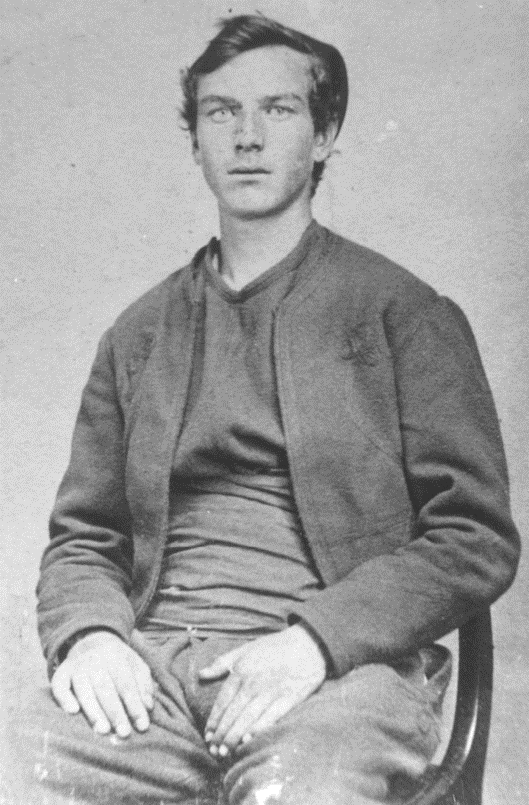 (USAHEC)