 | ||||||||||||||||||||||||||||


| ||||||||||||||||||||||||||||
|
The following historical information is about the service of both the regiment, and the men, of the "Ellsworth Zouaves" - Eleventh (11th) New York Volunteer Infantry Regiment, which served in the American Civil War from April 1861 to June 1862. If you have any corrections, suggestions, or additional information, photographs, artifacts, etc., that you wish to contribute, feel free to submit the information to the Webmaster.
Meanwhile there were certain legal forms that were necessary, and certain expenses that must be met. To supply the funds, a subscription was started and $30,768.50 subscribed, of which sum $10,000 was from the Merchants' committee. The Union defense committee came forward with an additional expenditure of $11,723; and the State authorities (up to August 15th,) with $15,542.91. They were authorized by the State Military Board, May 7th. "On motion of Attorney General - Resolved, That the ten companies, commanded by the following captains, to wit: John Coyle, Edward Byrnes, Michael C. Murphy, John Downey, John B. Leverich, William H. Burns, Michael A. Fagan, William Hackett, John Wilder, and Andrew D. Purtell, comprising the regiment called by some 'Ellsworth Zouaves,' who was said to be ordered to Washington to be mustered into service by a Government officer of the United States, and who are now in Washington without orders of the commander-in-chief, in consideration of the peculiar circumstances, be, and the same are hereby ordered to compose a regiment to be numbered No. 11, and that the election of regimental officers therein heretofore permanently made, be assumed and affirmed, and the said regiment and its officers be accepted, and the commander-in-chief requested to correct the muster-rolls to correspond to the men now actually in service." The regiment was armed, by State authority (April 28th), with Springfield muskets, pattern of 1842, caliber 69, and, by purchase, with bowie knives. It was amply supplied with uniforms, under clothing, havelocks, etc., received the most elegant flags, and took the field with great promise of usefulness. It arrived at Annapolis on the 2nd of May, and from thence was ordered to Washington and assigned to rooms in the Capitol. Here one of its first duties was to examine the arms with which it was furnished, and this led to the discovery that there were eleven different kinds of breechloading, and thirteen different sized bores among a thousand rifles. This defect, was soon remedied by an exchange for Minnie rifles. While in Washington the regiment had the opportunity to exhibit not only their peculiarities as Zouaves, but their efficiency as firemen. A heavy fire broke out near Willard's hotel, and Col. Ellsworth was applied, to for assistance. The order was given, and in a moment ten men from each company ran to the engine house, broke open, the door and rushed to the scene with the fire apparatus. Here they were speedily joined by most of their companions in arms; Col. Ellsworth took command, and, after desperate labor, succeeded in subduing the flames. For this service they were publicly thanked by General Mansfield, and rapturously applauded by the citizens. On the 9th of May, the regiment was sent to camp (Camp Lincoln) in the rear of the lunatic asylum grounds; and commenced drilling. On the 24th of May, at two a.m., it embarked in boats, landed at Alexandria, and took possession of the dock, and subsequently of the city. Here Col. Ellsworth proceeded to the roof of the Marshall House and tore down the secession flag which had been flying there for some days, and, while coining down stairs with it. was shot in the breast by a rebel named Jackson, and immediately expired. The assassin was almost instantly shot by Private Francis Brownell of Co. A. The body of Colonel Ellsworth was removed to Washington, and from thence to New York, and received every mark of respect that it was possible to bestow. After the affair at Alexandria, the regiment took up camp (Camp Ellsworth) in the vicinity of that city, and were subsequently engaged in the construction of Fort Ellsworth and in holding several points in the neighborhood. Here it was brigaded with the First Michigan and Thirty-eighth New York under Gen. Orlando B. Wilcox. Nothing of special interest occurred until the grand advance of July 17th was made, followed by the battle of first Bull Run. In this battle the regiment rendered efficient service in a hand-to-hand conflict with the famous Black Horse cavalry. "Ellsworth! Remember Ellsworth!" was the chorused battle-cry, and at each shout horsemen would fall. For a time, each man fought upon his own responsibility, and the orders of officers were lost in the din of the conflict and the excitement of the battle. Failing with their cavalry, the enemy threw upon the regiment their finest infantry and their petted "Louisiana Zouaves" 'in overwhelming numbers. This fresh force was three times repulsed, and it was not until the exhaustion of two hours fighting compelled, that it yielded the field. In this action the regiment lost twenty-four killed, forty-six wounded and fifty-two missing - many of the latter taken prisoners. The regiment was unfortunate. In the death of Colonel Ellsworth, it lost the embodiment of the pivotal idea in its organization. Col. Farnham, who succeeded him as well as any man could, died soon after the Bull Run affair. With no one in command in whom they had full confidence - with the particular idea upon which they had entered the service ignored - the members, of the regiment, or many of them, availed themselves of the disorganization at Bull Run to return to New York; officers resigned, and the demoralization became complete. In August, the rolls of the regiment gave the following results, viz: discharged, 31; killed, 24; wounded, 103; absent, 104; present, 606. Of the absent 20 were in hospital, and 43 in prison at Richmond. Through the intercession of the friends of the regiment, it was permitted to return to New York for reorganization, and in September performed guard duty on Bedloe's Island over the prisoners captured at Hatteras Inlet. From thence it was moved to a camp of instruction at Scarsdale, Westchester County, and from thence (September 17th, Special Orders No. 394) ordered to report for duty to General John Wool at Fortress Monroe. For a time, it appeared that the effort to reorganize would be successful. Colonel Looser worked faithfully to that end; the captains of nearly all the companies were changed, and every encouragement extended to the men and to recruits. The winter of 1861-2 was spent in camp at Newport News, and was varied only by the excursions of the CSS "Virginia;" in the attacks upon which vessel by the shore batteries the regiment rendered valuable assistance, and were highly complimented by, General Mansfield; while some of its members, who happened to be on board the ill-fated "Cumberland," fought with the last gun and brought away the fighting colors of the ship after she went down. Officers and committees in New York labored assiduously during the same period to obtain recruits. All was in vain, however - the spirit of the organization was in the grave with Ellsworth and Farnham. This fact was at last realized by friends, and early in June the regiment was returned to New York and mustered out of service. In 1863 an effort was made to organize a regiment under the old number "Eleven." Authorization for this purpose was first issued to James C. Burke on May 18th, 1863. This authorization was revoked June 7th, 1863, and given to Henry F. O'Brien, who was required to raise 250 men by the 1st of August, 250 by the 1st of September, and 250 by the 1st of November. Recruiting stations were established and some recruits obtained. In the July riot, however, Col. O'Brien was seized by the mob and brutally murdered. The organization seemed fated. On the 1st of October the authorization was withdrawn, and the recruits obtained transferred to the Seventeenth Veteran Infantry Regiment, then re-organizing for three years.
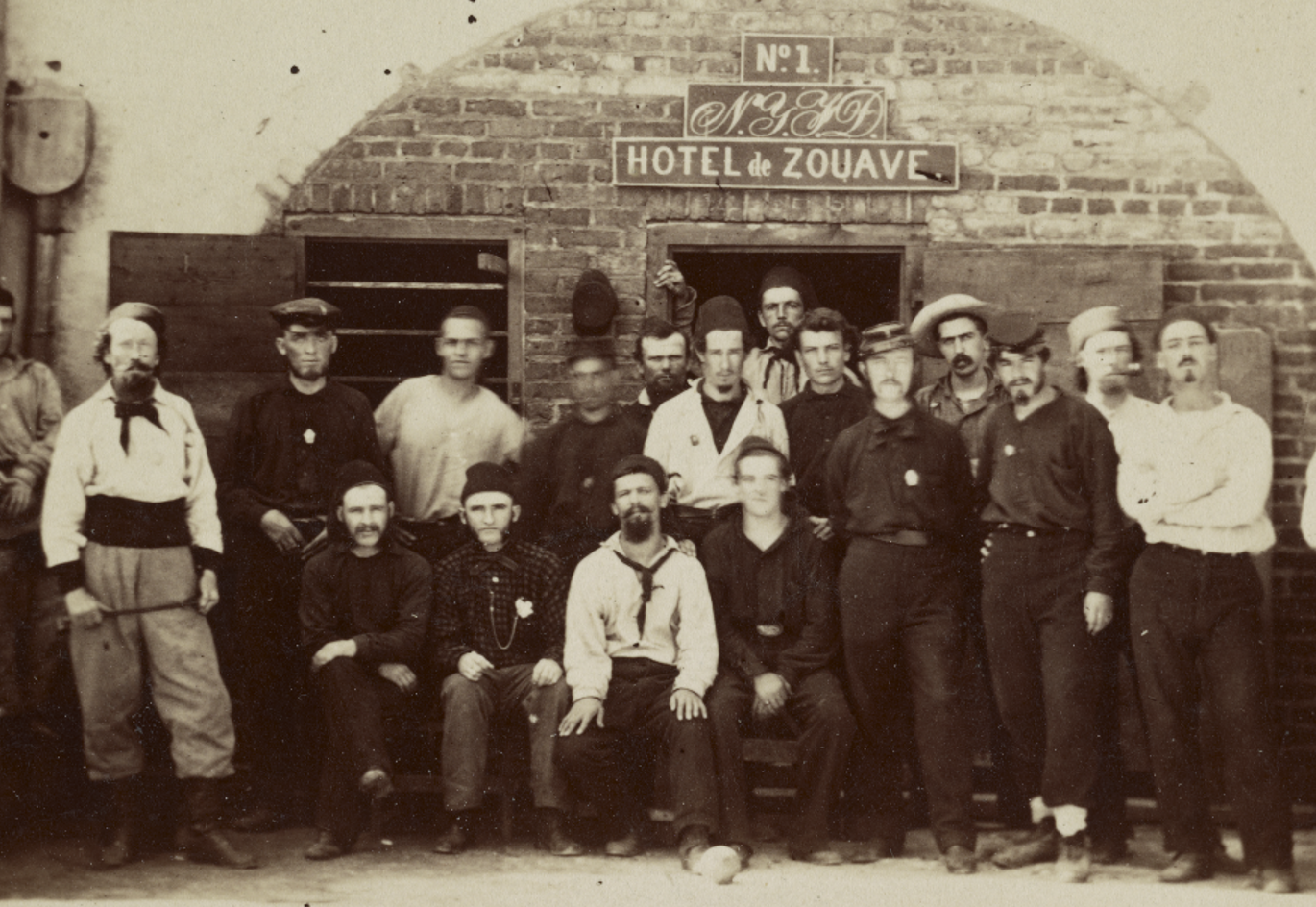 Group of Fire Zouaves captured at First Manassas, image taken at Castle Pinckney, South Carolina, ca. 1862(Library of Congress)
|
||||||||||||||||||||||||||||
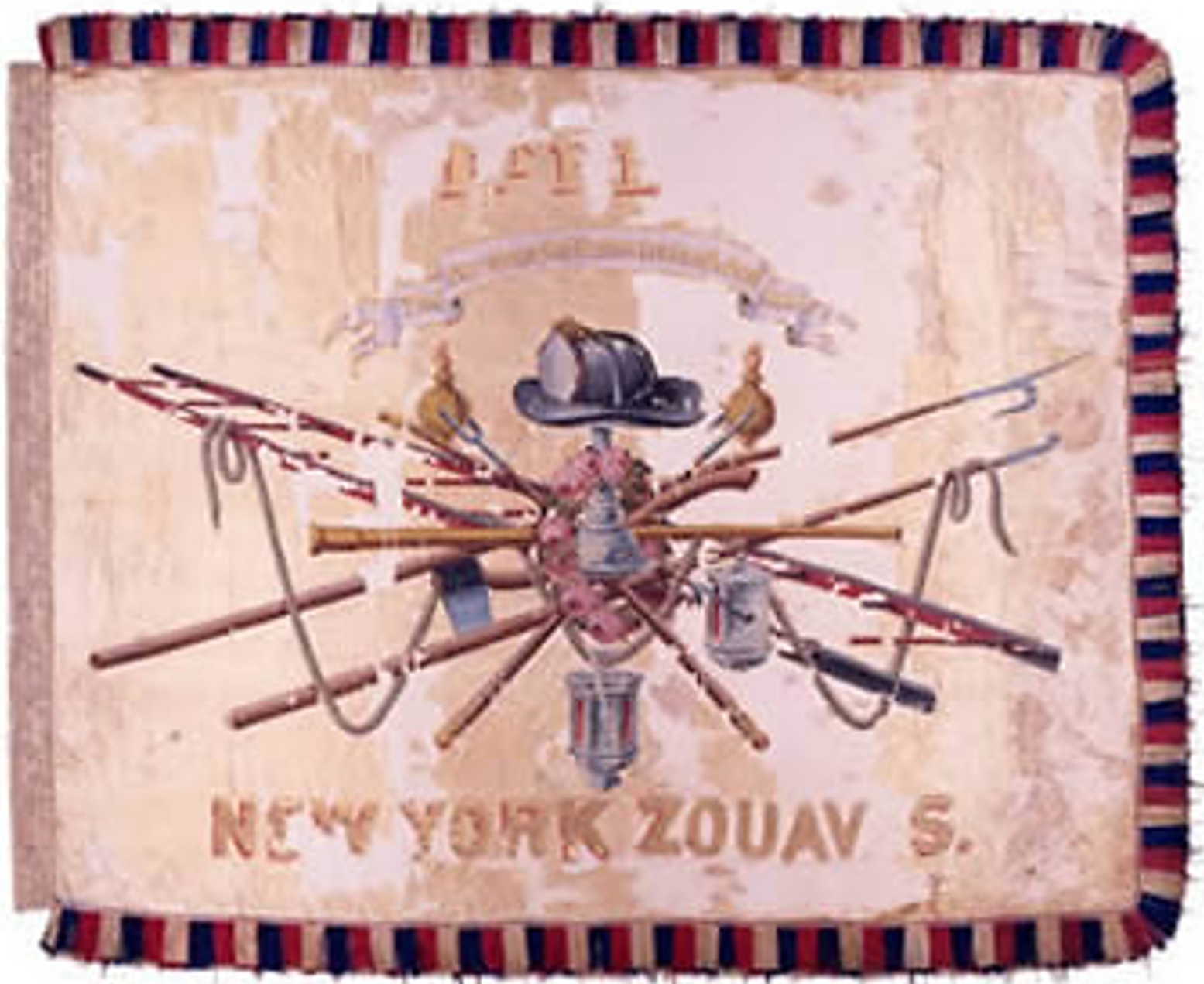 Regimental Flag(
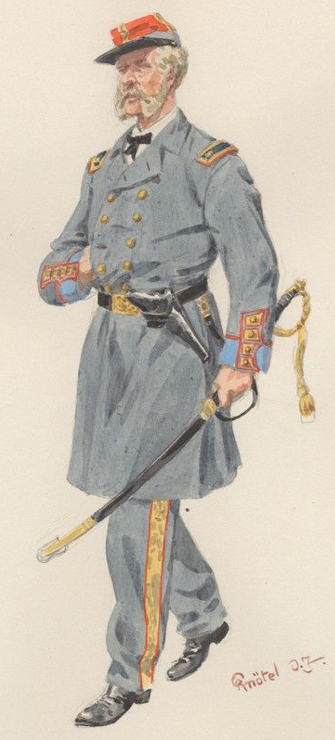 (Painting by Richard Knotel)
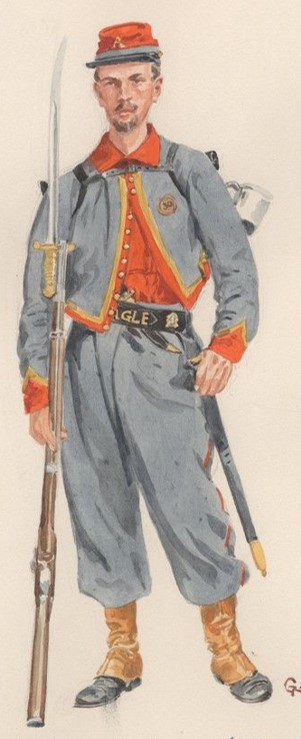 (Painting by Richard Knotel)