 | ||||||||||||||||||


| ||||||||||||||||||
|
The following historical information is about the service of both the regiment, and the men, of "Cladek's Zouaves - Thirty-Third (33rd) New Jersey Volunteer Infantry Regiment, which served in the American Civil War from July 1863 to July 1865. If you have any corrections, suggestions, or additional information, photographs, artifacts, etc., that you wish to contribute, feel free to submit the information to the Webmaster.
On the 8th of September the regiment, under orders from the War Department, broke camp, and the next morning embarking on transports lying in the Passaic, proceeded to Washington, crossing on the 13th into Virginia, and two days after marching for Warrenton, having in charge a train of thirty wagons loaded with supplies and ammunition. Upon approaching Warrenton it was found that General Meade had advanced to Culpepper, and that a body of rebel cavalry had occupied the abandoned town. Showing, however, a formidable front, the regiment boldly advanced, and, the enemy retiring, promptly occupied the place, going into camp in a strong position just outside of the village limits. Here the command remained until the 19th, when it proceeded to Warrenton Junction, Colonel Mindil hoping at that point to open communication with General Meade and procure orders as to his subsequent movements. In this he was successful, the regiment being ordered to report to General Howard of the Eleventh Corps, which, in connection with the Twelfth Corps, was guarding the line of the Orange and Alexandria Railroad. Here, with a view of preparing the regiment for action, which was regarded as imminent, four drills daily, of one hour each, were ordered, and the men rapidly increased in efficiency. The command, however, was not to measure strength with the enemy on that field. On the 24th, orders were received to prepare immediately for a movement. Inquiry at headquarters developed the fact that in view of the reverse at Chickamauga it was deemed necessary to immediately reinforce the Army of the Cumberland, then holding the defenses of Chattanooga, and that for this purpose the Eleventh and Twelfth Corps, under General Hooker, were to be dispatched to the West. This was a surprise to the men of the Thirty-third, but they promptly acquiesced, and on the morning of the 25th, the regiment set out for Washington, whence, the same night, it departed by rail for the West. Orders from General Meade to stop the regiment and return it to the Army of the Potomac, had been received by General Howard at Manassas, and by General Hooker at Washington, but in each case the regiment had departed before the dispatches came to hand. The regiment had been recruited with a view to service in the West, and it seemed destined to go there in spite of everything. From the Relay House, the regiment travelled by rail by way of Harper's Ferry, Grafton and Benwood, through the States of Ohio and Indiana to Indianapolis, and thence to Jeffersonville, where the Ohio River was crossed, and cars were taken from Louisville to Nashville, Tennessee, reaching the latter early on the morning of the 30th (September). Bridgeport, a military station on the Tennessee River, in the northeastern part of Alabama, and distant about two days march from Chattanooga, was reached the same evening, the regiment bivouacking for the night, and the following day establishing a regular encampment. Here, the command once more engaged in active drill, making such satisfactory progress as to elicit not only the warmest expressions of approbation from General Howard, but also a request for a permanent detail from the regiment for guard duty at Corps Headquarters. On the 18th of October, Colonel Mindil was ordered to proceed with three regiments to the mouth of Battle Creek, about six miles distant on the wagon road to Chattanooga, for the purpose of relieving General Morgan's Brigade of Western troops, then holding the place. The designated point was reached on the following day, and General Morgan's Brigade moving forward to Chattanooga, his quarters were at once occupied by the relieving brigade. This temporary brigade, to the command of which Colonel Mindil had been assigned, consisted of the Thirty-third New Jersey, Twenty-seventh and Seventy-third Pennsylvania, and Eightieth Illinois Volunteers, and their duty was to protect the pontoon bridge across Battle Creek, on the only wagon road to Chattanooga then in our possession, as well as to picket the surrounding country and assist the heavy trains of supplies in moving over the muddy and worn-out roads, which required frequent repairs, by new drain age, corduroy, &c. The Thirty-third regiment was assigned to the camp lately occupied by the Thirty-fourth Illinois, consisting mostly of small frame structures, which were welcome, indeed, as a protection against the heavy rains then prevailing. On the 21th of October, the three regiments were ordered back to Bridgeport to rejoin the corps, which had been ordered to advance, and Mindil was left alone with the Thirty-third regiment in this isolated position, to do the heavy labor formerly assigned to a brigade. On the 25th, he ordered forward to Jasper (a small village some five miles distant), two companies of about one hundred and twenty men, under Captain Boggs, to occupy the town and to send still further forward to the Sequatchie River a permanent picket of twenty men and one officer, to guard the bridge on the wagon road over that stream. Thus the roads, for a distance of six miles, were under the immediate care of the Thirty-third, and the men were constantly employed in guarding and repairing them. In the meantime (on the 26th), the Eleventh Corps, with Geary's Division of the Twelfth Corps, all under Hooker, had been ordered across the Tennessee to open the road to Chattanooga on that side of the river, it having been found impossible to supply General Thomas' army by the road held by the Thirty-third, and by the few steamers plying on the river between Bridgeport and " the front." Hooker moved forward and fought the successful battles of Lookout Valley and Wauhatchie - being the first victories achieved on Western ground by Eastern troops - driving the rebels from the valley up the sides of the mountain, and thus opening the road from Kelly's Ferry to Brown's, by which supplies could be forwarded direct to Chattanooga, by steamer, from Bridgeport to Kelly's Ferry, and thence by wagons to Brown's, where the Tennessee was crossed by a pontoon bridge. Had Hooker failed in this movement, directed by Grant, the consequences could not have been otherwise than most serious; Chattanooga would probably have been abandoned, since it was impossible to keep the army there in supplies; and the whole current of the war in that quarter would, almost inevitably, have been changed. There being no longer a necessity for the retention of troops at Battle Creek, the Thirty-third moved forward, on the 4th of November, to rejoin its corps in Lookout Valley, reaching the brigade camp on the morning of the 6th. This camp was situated behind earthworks, which had been constructed on the summit of the lower series of ridges separating the valley from the mountain held by the rebels. The Thirty-third was assigned a position in support of the first line of the brigade behind and at the foot of the ridge, but still partially in view of the enemy's position on the crest of Lookout. In this new encampment, the regiment renewed its drills, reviews and parades, and attained still higher efficiency - acquiring steadiness especially in the performance of actual picket duty in sight of the foe. The rebels amused themselves by continually shelling either the passing trains in the valley or the position of our forces on the surrounding, but lower hills, but their shots inflicted little damage, owing to the height of their position and depression of the guns. At length, on the 22nd of November, the regiment again moved out on active service, marching to Brown's Ferry, and thence, through the camps of Sherman's forces, who had arrived from the Mississippi, to and beyond the town of Chattanooga, where it bivouacked in front of Fort Wood. Grant had at this time arrived at Chattanooga, and his presence, with that of his faithful Lieutenant, Sherman, and the heroes of Donelson and Vicksburg, gave promise of hot work at no distant day. The morning dawned, but beyond an occasional discharge of ordnance, there was nothing indicative of preparations for battle. Indeed, our army spread out along the plain seemed more ready for grand review than for engagement, and so the enemy thought, as Bragg afterwards confessed. Noon came, but still no orders reached the Thirty-third, although on the extreme right the western troops had already commenced to advance. Soon a few rifle shots were heard, then brisk skirmishing, then volleys of musketry and rapid discharges of heavy artillery. Looking to the right, our gallant veterans were seen pressing bravely forward, steadily gaining ground. And now orders came to the Thirty-third "to unsling and pile knapsacks," and move diagonally forward to the left. Moving the short distance the corps was formed for action in two lines, the sounds of battle on the right growing momentarily louder. Soon, an aid from Howard having delivered orders, the brigade moved into the plain beneath and towards a clump of woods skirting Citico Creek, at a point where the Atlanta Railroad crossed a small stone bridge - the Thirty-third New Jersey and the One Hundred and Thirty-fourth New York forming the first line, and the Twenty-seventh and Seventy-third Pennsylvania and One Hundred and Fifty-fourth New York, a second line in support. The regiments of the first line at once sent out skirmishers to feel for the enemy and under their cover the advance was made. Captain Boggs, with Company A, deployed along the front of the Thirty-third, and about one hundred and fifty yards in advance, proceeded some twenty paces, when a heavy fire was opened upon him and the regiment from every side - from the woods in front, from under the stone bridge and from behind several small buildings in possession of the foe. Our object being to gain possession of these buildings and of the bridge in order to hold the line of the creek, the extreme left of General Thomas' army, the Thirty-third, for the first time in action, continued to advance, despite the heavy fire. Company A not being strong enough to push back the enemy's sharpshooters, who were well posted, Captain O'Connor, Company F, was advanced as a reinforcement, when Colonel Mindil led both companies to the attack. Under a brisk fire, the men still continued to gain ground, and the enemy soon retired behind the creek, still holding, however, the buildings and the bridge. But the advance was not made without loss. The brave Captain Boggs, while gallantly encouraging his men, was shot in the arm by a sharpshooter, and was obliged to leave the field, while several other casualties were suffered. The regiment now halted, awaiting the arrival of the troops on the right, but the fire from behind the buildings proving a serious annoyance to the men in the second line, Colonel Mindil was soon ordered to charge forward with his whole command and dislodge the enemy - which was done at once, the regiment, with a cheer, rushing to the assault. The enemy fired rapidly and wildly, and unable to resist our assault, the buildings were soon in possession of the assailants. But in this movement also the regiment suffered a severe loss, Captain Waldron, while bravely moving forward on the right of his company (I), on the extreme right of the regiment, falling dead, shot through the head by a sharpshooter from behind the very house which his company, only a few moments later, occupied. He had just received the order to take this building when the fatal bullet struck him. Brave and cool, in all respects an accomplished officer, the regiment in his death sustained a loss which could not easily be repaired. Lieutenant Toffey, of Company G, who had been directed to assume command of Company A after Captain Boggs was wounded, was likewise severely wounded before he had time to give an order. Thus far the regiment had acted nobly and gained several advantages of position, but its success was won at a costly price in the loss of these efficient officers. In the meantime, and while the regiment was charging in line, Captain O'Connor, with Companies F and A, had succeeded in gaining the banks of the creek, and had even pushed some of his men across on the flank of the enemy occupying the bridge, but the regiment having halted, the enemy directed all their fire against his little command, compelling him to apply for assistance to enable him to save his command. This had been foreseen by Colonel Mindil, who had already ordered forward Company E, Captain Charles Fields, with Major D.A. Peloubet accompanying, who was to establish the line in front. On reaching the front, the Major found several of O'Connor's men across the creek, and returning for orders, was directed to apprise the General commanding the division of the situation and ask for orders. Before he returned, however, orders were received to hold the line of the creek merely, and Adjutant Lambert was directed to convey the information to Captain O'Connor. Owing to the heavy fire of the enemy, the regiment was ordered to lie down close to the ground, so as to escape the constant shower of bullets - O'Connor's men meanwhile being protected by the trees from behind which they had driven the rebels. In order to reach O'Connor's position, however, it was necessary to pass over open ground, in full view of the enemy on the bridge, and this duty Adjutant Lambert performed with conspicuous gallantry. Mounting the Major's horse, he galloped forward under a heavy fire, when a well-directed shot carried his horse from under him. Not in the least disconcerted, he extricated himself from the fallen animal, and pushing bravely on, reached and delivered his orders to O'Connor, who, upon receiving them, immediately recalled his daring men and reestablished his line on one side of the creek. All having been gained that was desired, the regiment now merely directed its efforts to holding its position, which it did successfully. Night coming on, the Thirty-third was relieved by another (fresh) regiment of the brigade, and moved back to take its place in the reserve. It had fought its first battle, acting bravely and well, and the men as they bivouacked under the stars felt, justly, that they had sustained on that Western field the brilliant reputation which New Jersey soldiers had gained in the East. General Howard, who had witnessed the gallant charge and steadiness of action, warmly complimented the command on its splendid behavior. The aggregate loss of the regiment, considering the work accomplished, was not large, amounting to one officer killed and two wounded, and one private killed and twelve wounded. The entire army now ceased firing, and all rested for the night on the ground gained during the day from the pickets, advance guards and outlying reserves of the enemy. On the 24th the regiment was early formed in line, but the enemy having been dislodged from the bridge by a flank attack of other commands, it did not become engaged. Later, however, it was again called to dangerous service. During the previous night, under cover of the fighting of the Army of the Cumberland, Sherman had succeeded in laying pontoons across the Tennessee, near the mouth of the Chickamauga. Here he was to cross early on the morning of the 24th, and assail and turn the enemy's right, so as to interpose between Bragg and Longstreet, the latter being on his way to Knoxville. General Grant, learning that Sherman was crossing his forces, at once directed General Howard to establish a connection, and for this purpose Colonel Mindil was ordered to cross the railroad track, thence to cross Citico Creek below the bridge so stubbornly held by the enemy the night before, and, passing around their right flank, endeavor to reach Sherman, about a mile and a half distant. Under the direction of General Howard, Mindil effected the crossing of the creek, and at once made the necessary dispositions to advance, by throwing out skirmishers on the front and right. These skirmishers soon became engaged with the enemy, who was advantageously posted behind the railroad embankment, and General Howard fearing that the enemy might prove too strong, ordered two additional regiments - the Twenty-seventh and Seventy-third Pennsylvania - to Mindil's assistance, when the advance was continued, the brave and veteran Captain Bartlett guarding well, with Company I, the exposed flank of the Thirty-third. So well, indeed, did he maneuver his skirmishers, that the enemy was unaware of the march of the three regiments, and their junction with General Sherman was soon effected, without the loss of a single man. General Howard accompanied the command, and here for the first time met Sherman, with whom he was destined in the future to achieve such distinction. The day was already well advanced, and it was raining heavily; and but slight skirmishing appeared to prevail. As soon as Sherman's forces had crossed, the Thirty-third advanced with him - the post of danger, the exposed right flank, being assigned to that regiment. No enemy in any strength, however, was encountered, and the regiment bivouacked for the night at the foot of Mission Ridge, near the Tunnel, over which the enemy was strongly posted. Some of the Western troops had already gained portions of the crest, by surprising the enemy holding them. During the night, heavy defenses of stones and earth were thrown up, to serve as a base in the absence of connections with the rest of the army, and the men were told to be ready for action at daylight on the morrow. It was during the afternoon of this same day, the 24th, that - the enemy having massed nearly his entire force over the Tunnel to oppose Sherman - Hooker, with Geary's Division of the Twelfth Corps, and Osterhaus' Division of the Fifteenth Corps, carried the sides and crest of Lookout Mountain, planting the Stars and Stripes on its very summit, above the clouds and in plain view of both armies. The gains of the day, indeed, had been of the most brilliant character throughout. Sherman, on the left, had gained a fine position on the enemy's right. Thomas, in the center, held fast to the rebels posted there, in constant demonstrations; while Hooker, on our right, by his grand achievement, was placed in position to attempt the turning of the rebel left and the "rolling up" of his line - with scarcely a possibility of failure in the attempt. The morrow was to be the decisive day, and the night was spent by both armies in preparations for the deadly struggle. The morning of the 25th opened with sharp firing on our left, as Sherman carried crest after crest - the rebel artillery meanwhile thundering along our entire line and rendering our position exceedingly uncomfortable. At eleven o'clock, Sherman marshaled his forces for the assault of the rebel left on the Tunnel, and for this purpose the Thirty-third was moved to the right through the woods, then across a field, in full view of the enemy, into another piece of wood, directly opposite the Tunnel. The Seventy-third Pennsylvania, of the same brigade, was ordered to the front as skirmishers, and the Thirty-third placed in position in the rear of a fence, as a support. In moving forward to obtain this position, the regiment was subjected to a destructive shell-fire from the enemy's batteries, which caused some havoc in our ranks, but the line moved splendidly forward, occupied the allotted space and reclined behind the protection of the fence. Sherman's attack was heavy and spirited; but the heavy masses of the enemy defied assault, and at four o'clock, p.m., the regiments were withdrawn from the struggle to take post again behind their intrenchments. This heavy demonstration, however, had caused the enemy to reinforce heavily his right; and the left and center being weakened, Sherman seized his advantage, and pushing forward Thomas and Hooker, carried the enemy's left and center and drove him ingloriously from the ridge in his front. Owing to this success, the enemy also evacuated in Sherman's front during the night; and long before dawn of the 26th, the eager troops were ordered in pursuit. Thus had the Thirty-third taken a prominent part in three days of the heavy fighting of the ever-memorable battle of Chattanooga, and though raw and inexperienced, acquitted itself with the bravery and tenacity of their older, veteran comrades. The casualties in the fight at Mission Ridge, on the 20th of November, were then reported as follows: Company B - Corporal Henry Stern, shell, finger; Henry McDonnell, shell, finger. Company D - Wesley Conklin, shell, face. Company E - Samuel Searing, leg, killed. Company F - Julius Bachmeyer, shell, hip; Patrick McDermott, shell, knee. Company G - Lewis Mangold, shell, arm. The rest of the Eleventh Corps had now arrived, and at daylight of the 26th crossed Chickamauga Creek, moving down behind Mission Ridge in pursuit of the flying, disorganized foe. At night, the Thirty-third came up with the rear-guard of the rebels, who were dislodged after a brief skirmish, and the men bivouacked for the night some four miles from Graysville, through which place they marched next morning towards Parkin's Gap, with a view of turning the enemy, who were heavily engaging Hooker at King-gold. Colonel Mindil was now placed in command of the brigade, consisting of the Twenty-seventh and Seventy-third Pennsylvania, One Hundred and Thirty-fourth and One Hundred and Fifty-fourth New York and Thirty-third New Jersey, which command he held during the remainder of the campaign. In the absence of Lieutenant-Colonel Fouratt, who was sick at Nashville, Major Peloubet assumed command of the Thirty-third. The brigade remained at Parkin's Gap for two days, during which it destroyed the railroad at Red Clay, thus severing the communication between Bragg and Longstreet; but it had sterner work before it. On the 29th orders were received to move towards Knoxville, about one hundred and twenty miles distant, for the purpose of relieving Burnside, by coming up in the rear of Longstreet, who had invested the place; and on the same day, Sherman's army of the Mississippi, Davis' Division of the Fourteenth Corps, with the Fourth and Eleventh Corps, moved out to the performance of the task to which they were assigned. How that duty was performed by the Thirty third, the following diary of the march exhibits: "November 29th. Moved at six o'clock, a. m., towards Cleveland in a northeasterly direction, arriving there, after a heavy march of twenty-two miles, about five o'clock in the afternoon, just as the enemy's cavalry were galloping out of the town. "November 30th. Moved at six o'clock, a. m., for Charleston, arriving thereat two o'clock, p.m., driving the rebel cavalry precipitately across the Hiawasee. So rapidly was this done that the enemy had not time to destroy the bridge or a large train of cars well filled with flour, grain, pork and molasses; marched thirteen miles. "December 1st. Our troops across the Hiawasee, passed through Calhoun, after filling their haversacks from the rebel commissariat; then through Riceville and Athens, encamping for the night about two miles beyond the latter place, after a march of eighteen miles. "December 2d. Marched at seven o'clock in the morning via Sweetwater, encamping about five o'clock, p. m., after a march of seventeen miles, about two miles beyond Philadelphia. "December 3d. Moved at five o'clock, a. m., towards Loudon, six miles distant - the enemy having destroyed the bridge over the Holston at this point, wo cannot proceed further on their line, and amuse ourselves by shelling the enemy's cavalry, who are seen on the heights beyond the river. Information received that Burnside repulsed three successive charges of Longstreet on Sunday, but that he cannot hold on for more than three days longer. Two days half rations of coffee, sugar, flour and suet are issued, and we encamp for the night; our supplies of fresh meat were obtained by foraging cattle, sheep and hogs as we proceeded. "December 4th. Remained in camp all day while the pontoneers and engineers constructed a bridge over the Little Tennessee. "December 5th. Moved at one o'clock, a. m., crossing the Little Tennessee at David Ford at sunrise, on a bridge constructed of wagon bodies and wheels and trestle; moved through Unetia, arriving at Louisville at eight o'clock, p. m., after a fatiguing journey of twenty-two miles. "December 6th. Sunday, received the joyful intelligence of Longstreet's retreat, who fled on our approach, and were rejoiced at the consequent safety of Burnside and Knoxville. The troops were now halted twenty miles from Knoxville, and I rode into the city in company with Generals Sherman, Howard, Logan and Blair, and arrived at General Burnside's Headquarters. "December 7th. Moved at eight o'clock, a. m., toward Chattanooga, and after a march of seventeen miles encamped about a mile south of David Ford. "December 8th. Moved seventeen miles, encamping near Sweetwater in a heavy rain. "December 9th. Marched fifteen miles, encamping near Athens, remaining in this vicinity during the 10th and 11th, occupying the time in repairing the worn-out shoes of the command with some sole and upper leather found in the town. "December 12th. Moved through Charleston in a drenching rain, encamping, after a tramp of eighteen miles, two miles beyond. "December 13th. Moved to Cleveland, encamping on the Dalton Railroad, in the southeast portion of the town—remained there the 14th and 15th, awaiting rations from Chattanooga which arrived on the latter day. "December 10th. The march is resumed, and in a storm which excels all that have gone before it, we make McDonalds Gap, where we lie in mud without cover from the rain. "December 17th. Moved forward down along the Railroad past the old fighting ground of Tunnel Hill, over Citico Creek, around the base of Lookout, over the wood so lately picketed by the opposing forces into the old valley, and for the Thirty-third the campaign of a month's duration is finished. General W.S. Sherman, in dissolving his command, addressed to us these words in General Orders: "The General commanding thanks all officers and men for the promptness with which all orders were obeyed, more especially for the cheerfulness exhibited under privations of the severest kind. Without tents, without rations, with insufficient clothing, almost without shoes in mid-winter, this army sprang with a generous impulse and marched to Knoxville, a distance of one hundred and twenty miles, over the worst of roads, and relieved from danger twelve thousand of our fellow soldiers besieged by a dangerous enemy." "General Burnside warmly thanked the troops who saved him and his important stronghold. During the severe fighting, and still more severe marches, the regiment never flinched, and well earned for itself the commendation of their Division Commander, ' Boys, you have done well.' Never have I seen or even read of troops who suffered like these. They endured hardships that seemed unbearable, with a cheerfulness that appeared superhuman. We read of the sufferings of the patriots of '76 at Morristown and Valley Forge, and they were terrible; but even this was as nothing to the pains endured on the road from Chattanooga. The weather often wet, still oftener bitter cold, the woods deep with mire or frozen into sharp jagged points - all without blankets, tents, and many without shoes, with no regular rations, the men pressed on eager to overtake Longstreet. Had the ground been covered with snow, the march of the Thirty-third might have been traced by the bloody foot-prints of her patriot rank and file." The regiment now established a fine camp and went into winter quarters, where it remained until Sherman, having completed his plans for a movement against the enemy, once more drew out his army and commenced the memorable Atlanta Campaign. During the winter the Eleventh and Twelfth Corps being consolidated and designated as the Twentieth, under General Hooker, the Thirty-third was assigned to the Second Brigade of the Second Division, the latter commanded by General John W. Geary. The brigade having no general officer for commander, it was led in the following campaign by the senior Colonel, Colonel Mindil commanding it most of the time - Lieutenant-Colonel Fouratt, a brave and capable officer, having immediate control of the Thirty-third. The Atlanta Campaign. On the 4th of May, 1864, at four o'clock in the afternoon, the Second Brigade, then commanded by Colonel Bushbeck, of the Twenty-seventh Pennsylvania Regiment, broke camp, crossed Lookout Mountain and the State line of Tennessee, and bivouacked for the night on Georgia soil, near Rossville Gap. On the 5th, the march was resumed, the Twentieth Corps forming the center of the army, and encamping on the 6th near Pea-Vine Creek, On the 7th, the Thirty-third crossed Taylor's Bridge, near Gordon's Springs, and at night occupied an advanced position on picket, on the Rome Road, eight miles southwest of Dalton - moving on the day following in rear of the division as guard to the train. The Fourth and Twenty-third Corps being already engaged in demonstrating against the strong position of Tunnel Hill and Buzzard's Roost, General Geary was ordered to proceed to Dug Gap, about two miles south by west of Dalton, and demonstrate there by making a heavy assault. All these heavy demonstrations against impregnable mountain positions were designed by General Sherman to deceive the enemy, and divert his attention and his forces from the main point at which it was intended to perform the first of the series of grand strategic flank movements. On arriving at Dug Gap, Geary discovered before him a huge mountain over which ran a narrow road through a gap in the very summit. The mountain was covered with a heavy growth of trees and underbrush, and its sides were filled with loose rocks and boulders. It was most difficult of access, and the task before him was vastly more formidable than the storming of Lookout Mountain, when our troops were able to advance in line or solid column. But it was Geary who captured Lookout, and although but ordered to demonstrate effectively, he determined to attack vigorously and seek to dislodge the foe from their Georgian Gibraltar. Accordingly, placing his rifled artillery in position, he at once commenced to shell the Gap, and under cover of this cannonade he advanced the First and Second of his brigades to direct assault. For nearly an hour and a half these men heroically attacked, only to be repelled by an unseen foe at every assault. The rebels were on the crest of the mountain, behind rocks, trees and rifle-pits, and poured a murderous fire into the ranks of Geary's men, who had boldly advanced up the steep sides to within ten paces of its crest. At length, the position being found impregnable, Geary retired his line a few hundred yards, in order to reconnoiter again and to make different dispositions for a final attempt. Up to this time, the Thirty-third had not been engaged; but on hearing the firing in his front, and fearing our force was inadequate to the task in hand, Colonel Mindil pushed forward with his regiment, without orders, feeling himself justified, especially as the train was in no danger, in doing so by all the circumstances of the case. Upon reporting to General Geary at the front, he was ordered to make a detour of half a mile, then scale the ridge, endeavor to reach its summit and turn the enemy's left flank, while the main force occupied his attention in front. This order was at once obeyed. Mindil's force consisting, in addition to the Thirty-third, of the Twenty-seventh Pennsylvania and One Hundred and Thirty-fourth New York regiments. After toilsome effort, over and among rough, rolling boulders, the Thirty-third arrived near the top of the ridge, driving the enemy's skirmishers before it, when its progress was impeded by a long series of palisades, rising abruptly from the mountain sides, and which could only be passed through two or three small gaps, capable of admitting but one man at a time. Through these gaps the regiment filed, and, almost exhausted, formed line upon the rocks on the extreme right of our position, the One Hundred and Thirty-fourth New York being next on the left. To flank the enemy was impossible; his works extended along the crest of the mountain, which rose in a series of still higher palisades immediately in front. But one desperate hope of attaining the summit remained; that was seized, and Colonel Mindil, with the Thirty-third and One Hundred and Thirty-fourth New York, at once made disposition to carry the crest by direct assault. Heavy lines of skirmishers were thrown out, a storming column formed of the One Hundred and Thirty-fourth New York and four companies of the Thirty-third, the remainder of the Thirty-third going into position as a supporting line, to guard against pursuit by the enemy, if the charge should fail, or to dash forward to follow up its success. At length, all being ready, the storming party charged forward up the sides of the steep mountain, over treacherous, moving boulders, and under heavy volleys of musketry, up to the foot of the steep palisades, which defied assault. But undaunted by the frowning walls, with cheers and yells the men gallantly endeavored to reach the summit, and despite the terrible obstacles, many actually reached the crest, only to fall beneath the murderous bullet, or to be thrust headlong on the rocks below. At length, finding the position invulnerable, reluctantly and still fighting, the men fell back to their position on the lower crest, where they remained until dark, resisting every effort of the enemy to dislodge them. After nightfall, it now being clear that the capture of the rebel position was impossible, orders were given to withdraw; and in good order, slowly and silently, Colonel Mindil brought off the regiments under his command. No regiment could have behaved with more splendid valor than did the Thirty-third on this occasion. It was their stubborn attack, mainly, which compelled the detention of the enemy, who thus left open Snake Creek Gap, through which McPherson pushed without opposition, and Dalton, being flanked, was evacuated. The regiment lost in all two officers and four enlisted men killed, and two officers and twenty-three men wounded - several of the wounded subsequently dying. Among the killed was Captain Bartlett, who fell at the head of his column, gallantly charging upon the foe. He was an experienced, veteran officer, and had established a high reputation for coolness and courage in the battles of the Peninsula and in the Thirty-third. Lieutenant Joseph L. Miller, who also fell, was new to the service, but with his heart in the cause, he promised to become an excellent soldier, as he was undoubtedly one of the bravest of the brave. The bodies of both these officers were buried by the foe - the Masonic emblems on Captain Bartlett's person gaining for him a respectful burial. Colonel Mindil promoted the brave and dashing Cochrane, of Company K, to fill Captain Bartlett's place, but before the Governor's commission reached him, he too joined the host of martyrs, bravely falling at Pine Knob a month afterwards. The heavy labors of Colonel Mindil in the charge, leading up the mountain on foot, caused an old wound tore-open, and against his wishes, he was ordered to hospital for treatment. For his part in the action, though overlooked at the time, he was afterwards honored with the brevet rank of Major-General. 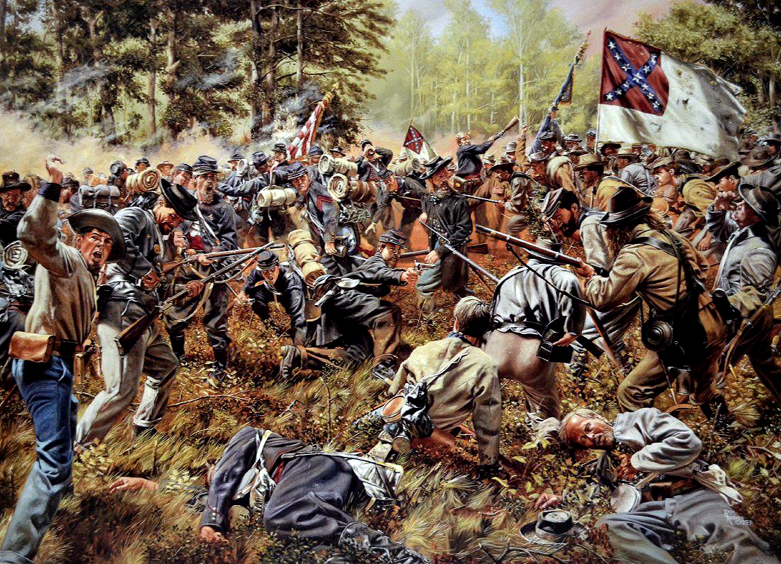 Painting by Rick Reeves of the 33rd New Jersey in the Action at Peachtree Creek, Georgia, July 1864. Painting by Rick Reeves of the 33rd New Jersey in the Action at Peachtree Creek, Georgia, July 1864.The Thirty-third remained with the division encamped near the foot of the mountain until the morning of the 11th, when under the command of Lieutenant-Colonel Fouratt, it moved to the left. The three following days were spent in marching, intrenching and picket-duty, when, early on the morning of the l5th, the battle of Resaca was commenced, the Thirty-third becoming actively engaged about ten o'clock, a, m., when it charged the enemy up a gentle slope, covered with thick pines, four or five feet high. Being, however, in the second line, the regiment was not able to fire, though exposed to the full force of the enemy's batteries. In this gallant charge, the Thirty-third planted its colors within ten paces of the enemy's fort, and effectually prevented his gunners using four pieces of artillery therein. But beyond this, the line could not advance without some destruction. A small ravine separated the Second Brigade, of Geary's Division, from Wood's Brigade, of Butterfield's, and this ravine was unoccupied, but was thoroughly commanded by the rifles of the left wing of the Thirty-third. About dusk the enemy assaulted Butterfield in force, and the regiment performed excellent service in pouring a destructive flank fire into the right of the enemy's crowded columns. Lieutenants Sutton and Cochrane, commanding Companies C and I, had charge of the advanced videttes of the regiment on that flank, and by their coolness and courage did much to encourage their men. As soon as it was dusk, it was determined to secure the guns which had been silenced, and accordingly the Thirty-third, with other regiments of the division, dug away the earth in front of the fort, and quietly fastening ropes to the coveted pieces dragged them into our lines - one being carried away by the Jerseymen who had shared the glory and danger of the charge. The loss of the regiment in this engagement was three men killed, one officer (Captain Bray,) and twenty-four enlisted men wounded. Lieutenant-Colonel Fouratt fought the regiment with signal ability, and on this, his first field of battle with the Thirty-third, gained that reputation for coolness and intrepidity which he ever afterwards enjoyed. On the 16th, the march was resumed, the Thirty-third crossing the Ostanaula and Connasauga rivers, and thence moving through Cassville, across the Etowah river towards Burnt Hickory. On the 25th, after crossing Pumpkin Vine Creek, the enemy was dis covered in force near Dallas, or New Hope Church, and about five o'clock, p.m., with the rest of Hooker's Corps, the Thirty-third became engaged, driving in the enemy's skirmishers and advancing until dark, when they reached a strong position of the rebels, defended by artillery. Here, for half an hour, the enemy's fire was very hot, and in this position the Thirty-third remained during the night, exposed to a drenching rain. On the morning of the 26th, finding further progress impossible, the regiment constructed for itself without much opposition from the enemy, a small line of logs and earth, behind which to rest with security. During the night, these intrenchments were enlarged and strengthened; and Hooker's Corps for seven days was compelled to remain in this position, during the hottest of weather, whilst Sherman was operating elsewhere. The only duty was that of picket, and this was unusually dangerous and arduous, every night producing a list of killed and wounded as the videttes were relieved. The two lines were here so close that no one upon either side dared to show his head above the breastworks. All change of pickets and guards took place after dark. Here the brave and talented Captain Field received the mortal wound from which he died ten days afterwards at Chattanooga. Probably the most wretched week of the "one hundred days' campaign" was that spent here; the opposing lines being within one hundred and fifty yards of each other, the firing was incessant; the stench from the dead bodies which could not be removed, was sickening and their sight discouraging; maggots covered the ground in thousands, and each succeeding day only added to the strength of the enemy's works. Each night's rest was disturbed by the call to arms half a dozen times in as many hours, and the men were completely broken down with excitement and want of rest, when, at length, Logan's Corps, after repulsing the enemy at Dallas, arrived to relieve Hooker's troops from this uncomfortable position. During the first day's engagement, and the subsequent seven days from May 25th to 31st, the Thirty-third lost one officer and five men killed and twenty-seven men wounded. On June 1st, the regiment was moved with the corps towards the left of the army, then forward towards " Big-shanty," then across Alatoona Creek to within three and a half miles of Acworth where on the 6th of June a camp was established, and a week's rest afforded to the men. All this time the Confederates were slowly retreating, fighting our army every step of the way. On the 14th of June the march was resumed, and a position taken up near the Fourth Corps, fronting the rebel position on Pine-Knob. On the afternoon of the 15th of June, Hooker advanced against the enemy, the Thirty-third at first being in the second or supporting line. The enemy slowly and deliberately retreating towards his works, the first line charged forward under a heavy fire, when the second line, in which was the Thirty-third, was also ordered to pass to the front and engage the foe. Again, as on other fields, the Thirty-third advanced in splendid order, as if on parade, though under a murderous fire, and soon gained an advanced position within seventy-five yards of the enemy's breastworks. This position they held with tenacity, despite the enemy's attempt to dislodge them, but at nightfall orders were received to be in readiness to fall back toa more secure position. Accordingly, Colonel Fouratt ordered but a slight work constructed of such logs and stones as were convenient. Much to his surprise, and to the misfortune of the regiments of the first line, the expected order did not come, and the morning found them inadequately protected, when the night might have been employed in defense. The enemy was very strongly posted above our men, and well protected, and at once availed himself of our exposed position to slaughter our troops by a system of most accurate sharp-shooting. The losses were frightful. The enemy's line of battle overlapping ours, he gradually worked it around more and more, and commenced to enfilade the Union line. While standing up and reconnoitering this enfilading flank movement, Adjutant Pierson was wounded, happily but slightly, so that the regiment did not lose his valuable services. A company of the One Hundred and Thirty-fourth New York was now ordered forward to check this movement, but were driven back with heavy loss after a gallant effort. Another force met a similar fate, when at last Company I, of the Thirty-third, Lieutenant John C. Smith commanding, was ordered forward, driving off the enemy's advance and checking his progress - Lieutenant Smith receiving a severe wound in the arm, which caused his transfer to hospital. But the work of death did not cease. Many of our men were killed lying behind the works by rebel sharpshooters, whom we found it impossible to dislodge. The brave and chivalrous Captain Cochrane, so distinguished in every fight, in attempting, with rifle in hand, to silence one of the more accurate of the rebel marksmen, was himself instantly killed. So passed the 16th of June, a day of anxiety and inaction, with its long list of killed and wounded. Throughout the Thirty-third acted nobly, and was highly commended by Generals Hooker and Geary for its bravery. It lost in this battle of Pine Knop, June 15th and 16th, one officer and thirteen men killed, and one officer and forty-three men wounded, the total casualties of the regiment during the campaign thus far being eight officers and one hundred and thirty-nine enlisted men. The heavy loss in officers best shows how gallantly the shoulder-straps of the regiment behaved. After this engagement, the Thirty-third participated in the skirmishes of Nance's Creek and Muddy Creek, and in protecting the flank of the assaulting columns of the Fourth Corps at Kene-saw. Moving in pursuit of the enemy by way of Marietta, the7th of July found the Thirty-third in camp near the Chattahoochee River, and in sight of the steeples of Atlanta, where they enjoyed a ten days' rest, whilst new supplies were hurried to the front. On the afternoon of the 17th of July, the brigade crossed the Chattahoochee, and on the 18th passed over Nance's Creek, advancing through the woods in line of battle towards Atlanta. On the 19th, Peach Tree Creek was crossed and a small line of defensive works constructed for the night. On the next day, the memorable 20th of July, the Thirty-third was ordered to advance with the rest of the division, the enemy having fallen back and offering no opposition. No one seemed to be aware of the approaching storm of battle. Brigades and divisions were massed in columns, without reference to alignment or strategic position, and even the necessary connections were not made. The ground in front was densely wooded and traversed with deep ravines, intersecting each other in every direction. The advance had not been explored, and the whole rebel army might easily have laid concealed, as indeed events eventually proved. Johnson had now been superseded by Hood, a bold and reckless fighter, but still no match for Sherman. About two o'clock, p. m., orders from General Geary directed Colonel Fouratt to occupy with the Thirty-third a knoll about five hundred yards in advance of a small temporary line of rifle-pits, which had been hastily thrown up by the First Brigade, and only long enough to cover a single battalion. The regiment at once marched over these works and formed line of battle in the road beyond, a line of skirmishers being deployed in front before the advance was made. Then came the command to "forward," and the movement began. Everything was still and ominous, so unusually so, indeed, that 'Colonel Fouratt, an old campaigner, expressed himself as sure of trouble ahead; and he was right. The knoll was reached, arms were stacked, the skirmishers told to advance a little further, and rails obtained to commence the construction of a little redoubt for the division artillery. Just then a tremendous volley saluted the skirmishers, passing over into the regiment, wounding Lieutenant Childs and others. For fifteen minutes the enemy continued to fire rapidly, but the Thirty-third replied as well, and held its position. That defense was of infinite value; it gave our army in the rear time to prepare, and so prevented, perhaps, great disaster. J3ut now the enemy, discovering that but a single regiment replied to his fire, made a flank movement towards the regimental right, coming down a ravine, at the same time attacking the left with a rush and a yell. Column after column was closing in on the right and left and front of the Thirty-third, when, deeming further resistance useless, and fearing capture if too long delayed, Colonel Fouratt reluctantly issued the order for retreat. But the enemy had already occupied most of the ravine in the rear of the regiment, and every soldier was compelled to escape for himself, the rebels in overwhelming numbers rushing onward, destroying the color guard and capturing the State flag, the color-bearer being shot dead. But there was no disgrace in this repulse, for the same force which succeeded in driving the Thirty-third, soon drove the entire division, and almost annihilated the Twentieth Corps. In fact, Hood's whole army had attacked the Thirty-third, and it was the spirited resistance of that regiment which gave our army time to form and repel the savage and unexpected assault. The Thirty-third was soon rallied again, around its national flag, and once more did admirable service in repelling the last onset of the enemy. The battle of Peach Tree Creek was the first of three tremendous dashing assaults by which Hood sought to retrieve the failing fortunes of the Confederacy. In all respects, it was a most desperate fight, and no regiment sustained a nobler part than the Thirty-third. Both Hooker and Geary again commended the bravery of the regiment. The loss of the regiment was over seventy in killed and wounded - Lieutenants Downes, Aspen and Warren being taken prisoners by the foe, Aspen being badly wounded. The 21st was occupied in burying the dead, and on the 22nd the regiment moved to within half a mile of the enemy's works surrounding Atlanta. Here heavy works were constructed, and the regiment was under constant fire for over a month, performing the heavy duty of the trenches and the dangerous one of picket. On the 2nd of September, the Thirty-third, with the rest of the brigade, under Colonel Mindil, was among the first troops to enter Atlanta. The Thirty-third left Chattanooga with over five hundred muskets, and entered Atlanta with a few over one hundred. Three hundred out of the five hundred men were either killed or wounded. It is believed that no regiment of that army can show a similar record. The March to the Sea. Upon entering the city of Atlanta, the Thirty-third was assigned a permanent camp to the right of the McDonough road, about a mile and a-half from the court house. In this camp it remained, devoting the time to drills and parades, and receiving complete outfits of clothing and camp and garrison equipage, until Sherman had completed his preparations for the March to the Sea. Its experiences in that campaign are thus narrated in Colonel Mindil's report: "Headquarters Thirty-third New Jersey Volunteers, Savannah, Georgia, December 26, 1864. Captain N.K. Bray, Acting Assistant Adjutant-General, Second Brigade:Captain: I have the honor to submit the following official report of the movements of my regiment, from the 2nd of September to the 21st of December, 1864: Upon entering the city of Atlanta, the regiment was assigned a permanent camp to the right of the McDonough road, about one and one-half miles from the court house. In this camp it remained, devoting the time to drills and parades, and receiving complete outfits of clothing and camp and garrison equipage. On the 5th of November, camp was broken, and the regiment moved with the brigade at three o'clock, p.m., out upon the McDonough road, camping two and one half miles from the city. On the 6th of November we returned to our old quarters. November 15th. Broke camp at seven o'clock, a.m., moved out upon the Decatur road. Camped at twelve o'clock, p.m., near Stone Mountain. 16th. Moved at eight o'clock, a. m.; led the corps. Marched fifteen miles, crossing Yellow river at Rock Bridge, and halting for the night five miles beyond it on the Sheffield road. 17th. Moved at half-past six o'clock, a. m., marching through Sheffield, over the Ulcofauhatchie, and encamped two miles from Social Circle. l8th. Moved at half-past five o'clock, a. m., passing Rudden, and camped at half-past five o'clock, p. m., one mile from Madison. 19th. Moved at five o'clock, a. m., passing through Madison. Halted for dinner at Buckhead Station, and continuing the march to within one and one-half miles of Oconee river, on Georgia Railroad, tore up track afternoon and evening. 20th. Moved at seven o'clock, a.m., towards Eatonton, passing Park's Bridge and Slade's Cross Roads. Camped near Dunning's tannery, at six o'clock, p. m. 21st. Moved at six o'clock, a. m., towards Eatonton. 22d. Struck Eatonton Branch Railroad, and passing through Milledgeville and over the Oconee River, camped two miles beyond it. 23d. In camp. 24th. Moved at ten o'clock, a. m., on road to Hebron. 25th. Passed through Hebron. 26th. Entered Sandersville, and passed on to Tennille, on railroad, and camped three miles beyond it. 27th. Moved at seven o'clock, a. m., and tore up seven miles of railroad, and marched to Davisborough. 28th. Brigade detached to guard the corps headquarters train. Marched to Spear's Station on railroad. 29th. Brigade again detached. Moved by by-road to Station Ten and a Half. Tore up railroad to bridge over Ogeechee river. 30th. Burned the bridge, and then marched to Louisville, via Watkin's Bridge, reaching camp of division at twelve o'clock, p. m. December 1st. Moved at eight o'clock, a. m., and camped beyond Birdsville. 2d. Moved at six o'clock, a.m., toward Millen. Camped at Buckhead Creek. 3d. Moved at ten o'clock, a.m., crossed Augusta and Millen Railroad; camped six miles beyond, on the Sylvania Road. 4th. Moved at half-past seven o'clock, a.m.; camped at Horse Creek. 5th. Marched fourteen miles and camped, leaving Sylvania to our left. 6th. Continued the march toward Springfield; roads very soft and marshy. Camped after a tedious march of six miles. 7th. Still continued the march toward Springfield, and camped for the night near it. 8th. Passed Springfield and marched twelve miles, camping near Zion's Church. 9th. Moved at ten o'clock, a. m., and struck Savannah road. First Division, Twentieth Army Corps, on our front, skirmished with the enemy, who had a battery in position covering the road. Camped for the night sixteen miles from Savannah. 10th. Pushing on, passed Harrison's plantation and the Fourteenth Army Corps. Struck Savannah and Charleston Railroad nine and one-half miles from the city, and camped five and one-half miles from it that night. 11th. Placed in position as reserves, on banks of Savannah river, opposite Hutchinson's Island, and confronting the enemy's right flank, being in rear of Third Brigade. 12th-20th we remained in the same position. 21st. Entered the city of Savannah at eight o'clock, a. m., and were assigned to camp on the parade of the city. During the entire campaign, the troops have subsisted upon the country, and found food of all kinds in abundance ; never suffering from scarcity of provisions. In front of Savannah they were unprotected by breastworks, being in the reserve line, and subject to a heavy fire of shrapnel and shell from the opposing batteries of the enemy in our front, and to a heavy and provoking fire from a confederate gunboat in the far channel, round Hutchinson's Island. 1 am happy to state but one casualty occurred, namely, the slight wounding of private Terence Sweeney, of Company D. Before leaving Atlanta, I received one hundred and thirty-six substitutes, nearly all being raw recruits, many of them foreigners and unable either to write or speak the English language; and, owing to physical disability caused by the exhaustion attendant upon so severe a campaign to new soldiers, many were compelled to leave the ranks at times, and by becoming separated from the regiment during its night marches, and being unable to intelligibly define their wants and ask the location of their regiment, have as yet failed to return, and are reported absent without leave. The larger part of them, it is to be hoped, are with some of the other corps, and will soon find their way into camp. The command needs a complete outfit of clothing, shoes, etc., and will then be ready for a new campaign, as both health and esprit are excellent. G.W. Mindil, Colonel Commanding Thirty-third New Jersey Volunteers." Campaign of the Carolinas. The armies of Tennessee and Georgia, constituting the invading column of General Sherman, rested at Savannah for about one month, when the grand march through the Carolinas was commenced. The Thirty-third Regiment was commanded by Colonel Fourat, and was in the Second Brigade (Second Division, Twentieth Corps), commanded by General Mindil. After a campaign of six weeks Goldsboro was reached. The marching averaged fifteen miles per day, the troops subsisting entirely upon the country, and being mostly employed in the destruction of bridges and railroads, manufactories, rebel storehouses, and cotton. The Army of Georgia, commanded by General Slocum, (with which the Thirty-third was identified) was assigned the left flank of the column, being that in the direction of the enemy. The Thirty-third marched North from Savannah about forty miles, and then crossed over into South Carolina, at Sister's Ferry, moving via Robertville and Lawtonville (villages which the troops completely destroyed), to the Salkahatchie Swamp. Here, after many days labor in bridging and corduroying and some skirmishing, a crossing was effected and the march resumed towards Blackville, a small village and station on the Augusta and Charleston Railroad. Here, while Kilpatrick was fighting at Aiken on the left, and Howard on the crossing of the Edisto on the right, Mindil's Brigade was employed in the destruction of about half a mile of railroad track. The ties and sleepers were burned to cinders, while the rails - after being intensely heated - were bent and broken or twisted into spiral coils, rendering them altogether useless. The most of February was very wet, and the troops were constantly employed in rendering passable for our immense trains, the miserable roads through the wet and damp Carolina swamps. The army was now approaching Columbia, the Thirty-third moving on the Lexington road. The country was full of swamps, and the rebel cavalry was constantly in our front, but the men toiled slowly forward both night and day. Finally, the North and South Forks of the Edisto were crossed after driving off the enemy, who made a stand with artillery and cavalry - the Thirty-third, however, sustaining no loss in these encounters. The army under General Howard having entered Columbia, just as the Second Brigade approached it from the left, the course of the latter was still further deflected, the commandant being ordered to pontoon the Saluda and Broad Rivers, and proceed up the railroad towards Salisbury, North Carolina. This movement was but a feint, designed to induce the rebels to mass on our left, while the right wing moved rapidly under this diversion, via Camden and Cheraw into Eastern North Carolina. The Second Brigade advanced to Winnsboro, South Carolina, destroying the railroad from there to White Oak Station, about five miles; other troops being engaged in a similar duty to the southward. The rebels had retired to a point behind Chesterville, and on demonstrating in that direction with cavalry, they crossed the Catawba determined there to impede our progress - Sherman having totally blinded the enemy respecting his intentions and destination. The army was now ordered to make a rapid right wheel, our left flank moving east and northeast, crossing the Catawba near Rocky Mount, and the Pee Dee near Cheraw. The Thirty-third then crossed the border into North Carolina and struck a coal railroad to Wilmington near Lumberton, where it destroyed about a mile of track. It now moved through a deserted country, hardly affording supplies for the men, and reached Fayetteville, where connection was formed after five weeks absence, with Terry at Wilmington, by means of light draught gunboats, which had ascended the Cape-Fear. The rebels had now comprehended our purpose, and as Schofield was advancing from Newbern they determined by a desperate blow to prevent the fatal junction. Goldsborough was the objective both of Sherman and Schofield, and after the former left Fayetteville to resume his march, Johnson rapidly massed his troops at Averysboro and Bentonville, determined to make a last effort for the defense of the tottering Confederacy. At Averysboro a few divisions of the rebel army engaged the First and Third Divisions of our Twentieth Corps, but after a brilliant fight were compelled to retire, when the army was advanced cautiously, on near and parallel roads, and the trains heavily guarded. The weather was wet and stormy, and the marches through the swamps and bogs most exhausting. Mindil frequently marched his troops both night and day in constant rain, felling and splitting timber most of the time, so as to build roads upon which the trains might pass in safety. At times, leaving camp at four o'clock in the morning, working and toiling all day, midnight found the regiment but six miles in advance. But the troops maintained cheerful spirits, determined to overcome all obstacles. At Bentonville, Johnston struck Slocum, while on the march, when a desperate and undecided battle ensued, lasting all day. Sherman ordered the right wing of the army to Slocum's support, and after gallant fighting they made the necessary connection, when Johnston, without waiting for the dawn of day, retreated during the night in the direction of Raleigh. During the engagement, the Second Brigade was assigned to the hazardous duty of convoying to a place of safety the immense trains of the army; a service which was highly appreciated by the superior officers. The army reached Goldsboro in safety, having traversed the entire length of the State of South Carolina, destroying all the principal railroads connecting Lee's army with its base, and consuming the greater part of the provisions, means of subsistence and forage in that hitherto inaccessible region of the South. Besides this, Sherman was within easy marches of Grant, and the theater of war became narrowed to a district but a few hundred miles in extent. The campaign of Georgia and the Carolinas virtually decided the fate of the Confederacy. At length, Grant being ready for his final move, the campaign of Raleigh, the last of the war, was opened. Moving in rapid pursuit of Johnston, Sherman's veterans, at Smithfield, North Carolina, received the gratifying intelligence of Lee's surrender, hailing it with jubilant demonstrations. Near Smithfield, and for an entire afternoon, the Thirty-third regiment successfully fought the retreating rebel cavalry, and there fired the last shots of the war. Johnston's surrender soon followed, and about a week after the homeward march was resumed, by way of Weldon, Five Forks, Richmond and Fredericksburg, the Thirty-third reaching Washington in time to participate in the grand review of the Armies of the Republic. The Thirty-third was retained in service until August 2nd, lying near Alexandria, when it was ordered to be mustered out, and proceeded to Newark. This regiment, in a little less than two years, traversed a distance of two thousand five hundred miles, over one thousand seven hundred of which were accomplished by marching. It fought in eight battles, and engaged in over a dozen skirmishes. Although but two years in service, the losses of battle and campaign were such that the regiment was twice filled. That the Government highly appreciated the services of the regiment, the number of brevets conferred upon its officers clearly shows.
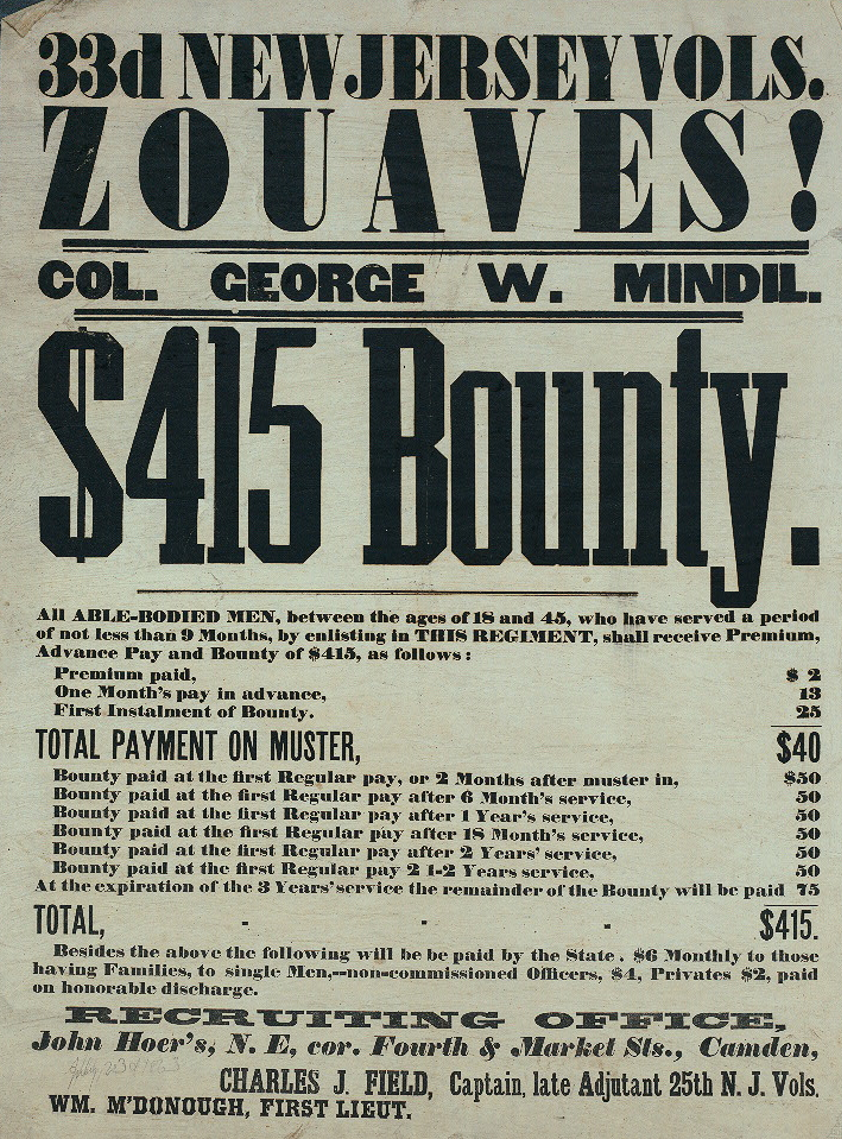
After being mustered into service the regiment was received from the State of New Jersey - 880 forage caps (zouave), 932 uniform jackets (zouave), 890 sashes (zouave), 889 pair leggings (zouave), 931 vests (zouave), 958 pairs of trousers (zouave), 34 pairs of trousers (infantry), 934 flannel sack coats, 1,1911 knit shirts, 1,883 pairs of drawers, 946 pairs of shoes, 1,826 pairs of socks, 1,061 blankets, 34 knapsacks, 953 haversacks, 852 canteens, 393 Enfield Rifle Muskets, 464 Springfield Rifle Muskets, 877 cartridge boxes, 877 cartridge box plates, 96 cartridge box belts, 100 cartridge box plates, 877 bayonet scabbards, 877 waist belts, 877 waist belt plates, 877 gun slings, 877 cap pouches and picks and 1,000 ball cartridges.
|
||||||||||||||||||

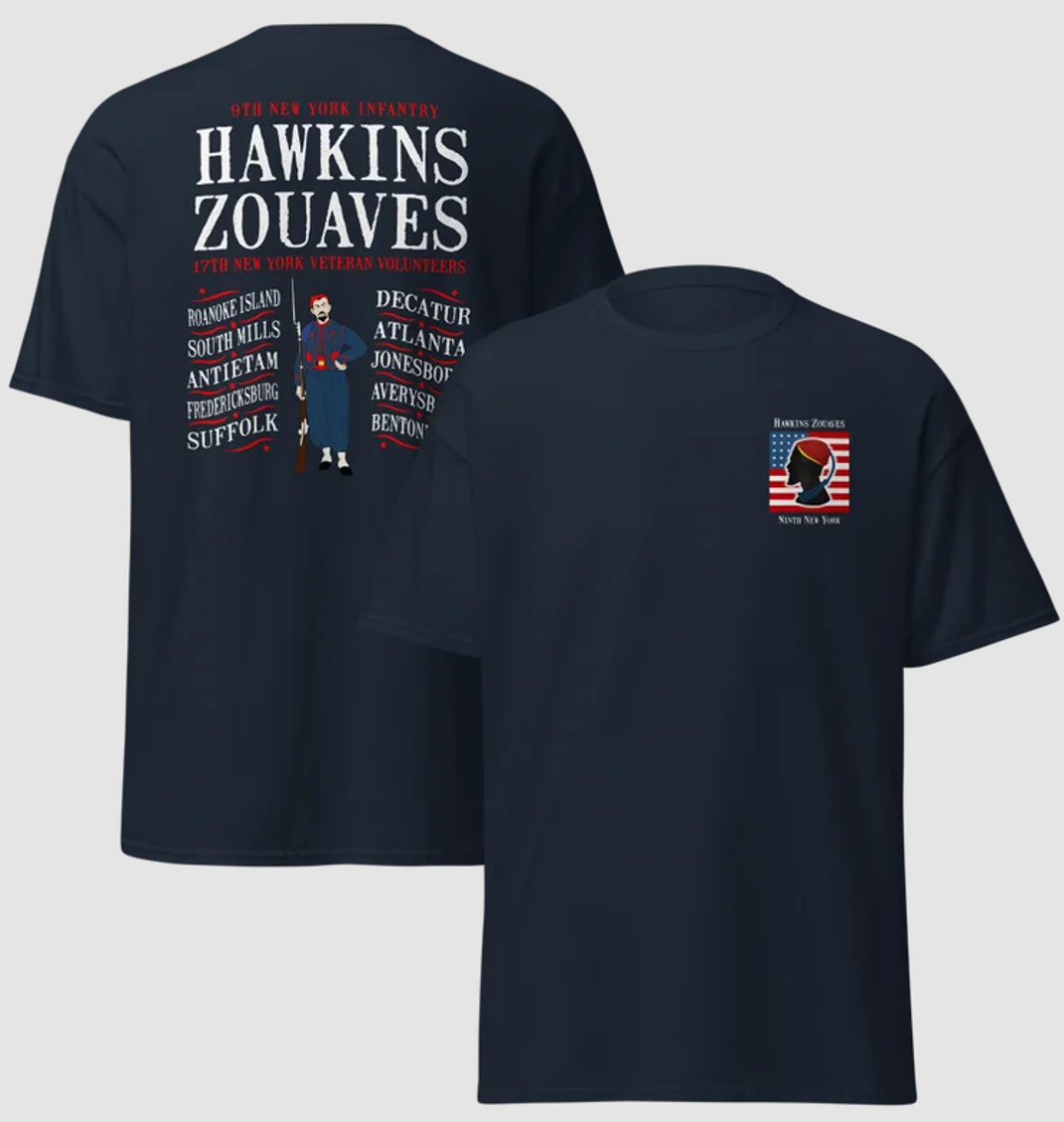
 (
(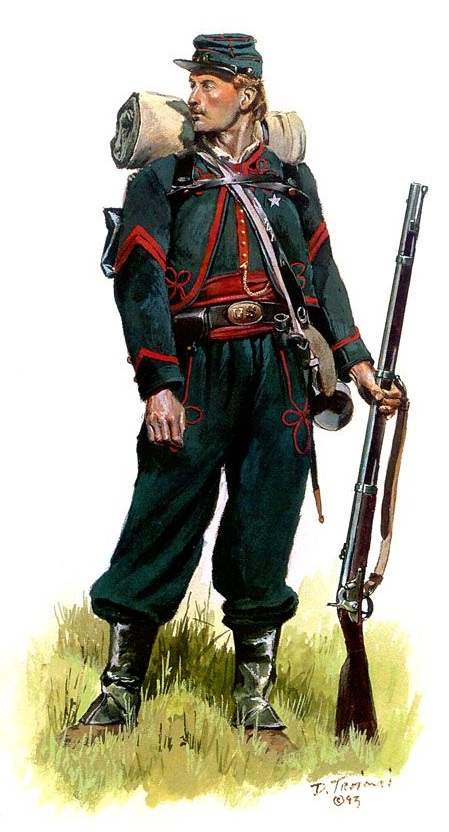 Artist's Rendition Enlisted Uniform(
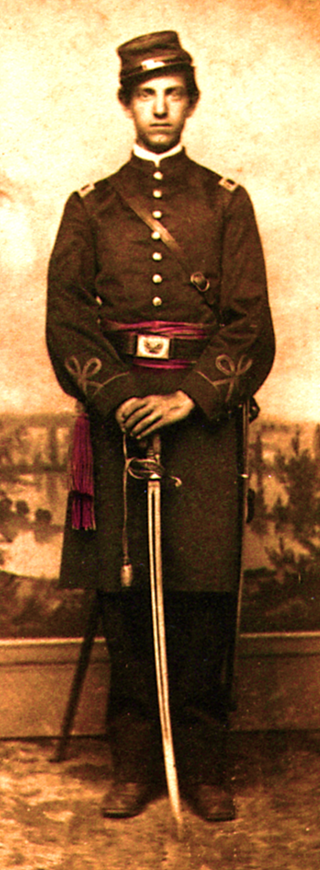 Lt. J.J. Toffey Officers Uniform(Source Unknown)
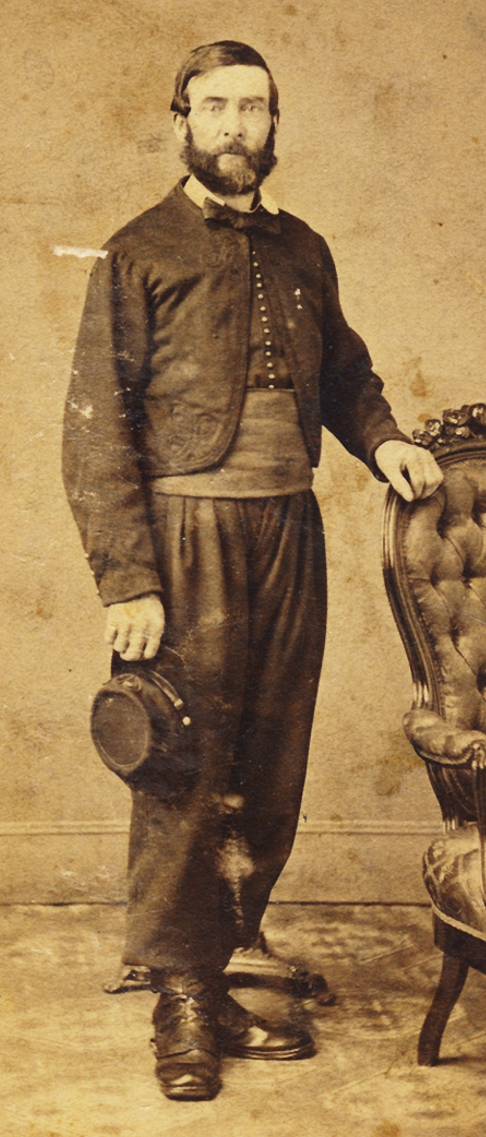 Unknown Enlisted Uniform(