Second (2nd) Infantry Regiment
South Carolina Volunteers, February 2nd, 1861,to April 9th, 1865


The following historical information is about the service of both the regiment, and the men, of the "Palmetto Regiment" - Second (2nd) South Carolina Volunteer Infantry, which served in the American Civil War from February 1861 to April 1865. If you have any corrections, suggestions, or additional information, photographs, artifacts, etc., that you wish to contribute, feel free to submit the information to the Webmaster.

Organization
Assignments
Timeline
Flags
References

Did you find this website helpful?
Would you like to support the S.C. Volunteer Archives?
Visit our Store Front at the

RIFLEMEN'S WORKSHOP

And get yourself a shirt
to show your Regimental Pride and Support for this site!

  REGIMENTAL ORGANIZATION

 
REGIMENTAL ORGANIZATION FROM FEBRUARY TO APRIL 1861

Regimental Field & Staff
Company A - Richland District - Governors Guards
Company ? - Lancaster District - Lancaster Grays
Company C - Richland District - Columbia Grays
Company ? - Richland District - Richland Guards
Company D - Sumter District - Sumter Guards
Company ? - Sumter & Clarendon District's - Chicora Guards
Company E - Kershaw District - Camden Volunteers
Company ? - Richland District - State Rights Guards
Company ? - Kershaw District - DeKalb Rifle Guards
Company ? - Darlington & Sumter Districts - Claremont Rifles

REGIMENTAL ORGANIZATION FROM APRIL 1861 TO APRIL 1865

Regimental Field & Staff
Company A - Richland District - Governors Guards
Company F - Abbeville District - Secession Guards
Company B - Greenville District - Butler Guard
Company G - Kershaw District - Flat Rock Guards
Company C - Richland District - Columbia Grays
Company H - Lancaster District - Lancaster Invincibles
Company D - Sumter District - Sumter Guards
Company I - Charleston District - Palmetto Guard
Company E - Kershaw District - Camden Volunteers
Company K - Charleston District - Brook Guard Volunteers

 
  ASSIGNMENTS

 
February to May 1861 - Nelson's Brigade, Bonham's Division, S.C. Militia

May to June 1861 - Bonham's Brigade, Department of Alexandria

June to July 1861 - Bonham's Brigade, Army of the Potomac

July to October 1861 - Bonham's Brigade, 1st Corps, Army of the Potomac

October to November 1861 - Bonham's Brigade, 3rd Division, 1st Corps, Potomac District, Department of Northern Virginia

November 1861 to March 1862 - Bonham's-Kershaw's Brigade, Van Dorn's-Early's Division, 1st Corps, Potomac District, Department of Northern Virginia

March to April 1862 - Kershaw's Brigade, Department of the Peninsula

April 1862 to June 1862 - Kershaw's Brigade, McLaws' Division, Magruder's Command, Army of Northern Virginia

June 1862 to September 1863 - Kershaw's Brigade, McLaws' Division, 1st Corps, Army of Northern Virginia

September to November 1863 - Kershaw's Brigade, McLaws' Division, Longstreet's Corps, Army of Tennessee

November 1863 to April 1864 - Kershaw's Brigade, McLaws'-Kershaw's Division, Department of East Tennessee

April to August 1864 - Kershaw's-Conner's Brigade, Kershaw's Division, 1st Corps, Army of Northern Virginia

August to October 1864 - Conner's Brigade, Kershaw's Division, Valley District, Department of Northern Virginia

November 1864 to January 1865 - Conner's-Kennedy's Brigade, Kershaw's Division, 1st Corps, Army of Northern Virginia

January to March 1865 - Kennedy's Brigade, McLaws' Division, Department of South Carolina, Georgia & Florida

March to April 1865 - Kennedy's Brigade, McLaw's-Walthall's Division, Hardee's Corps, Army of Tennessee

 
  REGIMENTAL TIMELINE

 
December 17th, 1860: Per act of the South Carolina State Legislature the regiment is authorized.

February 2nd, 1861: The regimental Field Officers are elected, with Joseph Brevard Kershaw as Colonel, James Douglas Blanding as Lieutenant Colonel and Dixon Barnes as Major.

March 12th, 1861: The regimental organization is completed for State service.

April 9th, 1861: The regiment is mustered into State service as the Second (2nd) South Carolina Volunteer Infantry Regiment.

April 9th to 15th 1861: Served in the operations in and around Charleston Harbor, South Carolina.

April 12th & 13th, 1861: On duty on Morris Island during the bombardment of Fort Sumter, South Carolina.

April 1861: Of the original 10 companies, only 4 (A, C, D & E) volunteer to enter Confederate service and go to Virginia; the other 6 companies either disband or reorganize as part of other regiments.

April 24th, 1861: Under the command of Colonel Kershaw, the four companies move to Richmond, Virginia; later to be joined by six (6) additional companies recruited for the regiment.

May 22nd & 23rd, 1861: The regiment is mustered into Confederate States service at Camp Davis near Richmond, Virginia.

June to July 1861: Served in the Manassas Campaign (Virginia).

July 18th, 1861: Engaged at Mitchell's Ford, Virginia.

July 21st, 1861: Engaged at Manassas, Virginia.

September 25th, 1861: Engaged in the action at Lewisville, Virginia.

May 14th, 1862: The regiment is reorganized for two years' service.

April to July 1862: Served in the Peninsula Campaign (Virginia).

April 5th to May 4th, 1862: Engaged in the defense of Yorktown, Virginia.

May 5th, 1862: Engaged at Fort Magruder near Yorktown, Virginia.

June 18th, 1862: Engaged in the skirmish on Nine-Mile Road near Richmond, Virginia.

June 26th to July 1st, 1862: Engaged in the Seven Days Battles near Richmond, Virginia.

June 29th, 1862: Engaged at Savage Station, Virginia.

July 1st, 1862: Engaged at Malvern Hill, Virginia.

September to October 1862: Served in the Maryland Campaign.

September 12th & 13th, 1862: Engaged at Harpers Ferry, Virginia.

September 17th, 1862: Engaged at Sharpsburg, Maryland.

November to December 1862: Served in the Rappahannock Campaign (Virginia).

December 11th to 15th, 1862: Engaged at Fredericksburg, Virginia.

April to May 1863: Served in the Rappahannock Campaign (Virginia).

April 30th to May 3rd, 1863: Engaged at Chancellorsville, Virginia.

May 3rd & 4th, 1863: Engaged at Salem Church, Virginia.

June to July 1863: Served in the Pennsylvania Campaign.

July 2nd to 3rd, 1863: Engaged at Gettysburg, Pennsylvania.

July 6th to 16th, 1863: Engaged at Hagerstown, Maryland.

September 9th, 1863: The regiment, with brigade, is enroute from Richmond, Virginia, to Dalton, Georgia.

September 1863: Served in the Chickamauga Campaign (Georgia).

September 19th & 20th, 1863: Engaged at Chickamauga, Georgia.

October to November 1863: Served in the Chattanooga Campaign (Tennessee).

November 1863 to January 1864: Served in East Tennessee Campaign.

November 15th, 1863: Engaged in the skirmishes at Loudon and Lenoir's Station, Tennessee.

November 16th, 1863: Engaged at Campbell's Station, Tennessee.

November 19th to December 4th, 1863: Engaged in the Siege of Knoxville, Tennessee.

November 29th, 1863: Engaged in the attack on Fort Sanders near Knoxville, Tennessee.

December 14th, 1863: Engaged at Bean's Station, Tennessee.

March 1864: The regiment re-enlists for the duration of the war.

May to June 1864: Served in the Overland Campaign (Virginia).

May 5th to 7th, 1864: Engaged at the Wilderness, Virginia.

May 8th to 21st, 1864: Engaged at Spotsylvania Courthouse, Virginia.

May 23rd to 26th, 1864: Engaged at Hanover Junction along the North Anna River, Virginia.

May 31st to June 12th, 1864: Engaged at Cold Harbor, Virginia.

June to August 1864: Served in the defense of Richmond & Petersburg, Virginia.

June 15th to 19th, 1864: Engaged at Petersburg, Virginia.

July 27th to 29th, 1864: Engaged at Gravel Hill, Virginia.

August to November 1864: Served in the Shenandoah Valley Campaign (Virginia).

August 21st, 1864: Engaged in the skirmish at Halltown, West Virginia.

August 26th, 1864: Engaged at Charleston, West Virginia.

September 13th, 1864: Engaged at Berryville, Virginia.

October 7th, 1864: Engaged near Port Republic, Virginia.

October 13th, 1864: Engaged at Hupp's Hill, Virginia.

October 19th, 1864: Engaged at Cedar Creek near Middletown, Virginia.

November 1864 to January 1865: Served in the defenses of Richmond & Petersburg, Virginia.

January to April 1865: Served in the Carolina's Campaign.

January to February 1865: On duty along the Salkehatchie River, South Carolina.

February 28th, 1865: Engaged in the skirmish near Cheraw, South Carolina.

March 11th, 1865: Engaged in the action at Fayetteville, North Carolina.

March 14th, 1865: Engaged in the skirmish near Silver Run Creek, North Carolina.

March 15th, 1865: Engaged in the skirmish near Smith's Mill on the Black River, North Carolina.

March 16th, 1865: Engaged at Averysboro, North Carolina.

March 19th to 21st, 1865: Engaged at Bentonville, North Carolina.

April 9th, 1865: The regiment is consolidated with the 20th South Carolina Infantry Regiment and the 1st, 2nd, 6th & 7th Reserve Battalions to form the 2nd South Carolina Consolidated Volunteer Infantry Regiment at Smithfield, North Carolina.

 
  REGIMENTAL COLORS (FLAGS)

State Regimental Flag. The first Regimental Flag carried by the Second (2nd) South Carolina Volunteer Infantry Regiment was presented to the four companies under Colonel Kershaw before departing for Virginia. In a ceremony on April 25th, 1861, at Charleston, ex-Governor John Lucas Manning presented a blue silk state flag to the Regiment on behalf of the ladies of Sumter, South Carolina, who had commissioned the flag. A description of the ceremony and flag was given in the April 26th, 1861, edition of the "Charleston Daily Courier" which wrote that the flag was "...of the finest Parisian silk, and doubled. It is of the usual regimental size, six feet long and four feet wide, with a blue silk Union, a Palmetto Tree worked with white floss silk, with an increscent on the right-hand comer. The trimming is of golden fringe with golden tassels. On one side is the inscription: "Second Regiment South Carolina Volunteers, 1861," encircled by a wreath of honeysuckles, with roses in full bloom."

Accepting the flag on behalf of the regiment, Colonel Kershaw handed it to Private Hugh Richardon Garden (1840-1910) of Company D (Sumter Guard) who would be appointed as the Regimental Color Sergeant and carried the flag throughout its use. The flag was likely retired and returned to South Carolina after the presentation of the 1st Issue Battle-flags to Bonham's Brigade in November 1861. It's whereabouts and history after that date are unknown.


1st Issue Battle Flag. In November 1861 the regiments of Bonham's Brigade were issued new Battle-flags to take the place of the individual state and company flags that were being carried by the units in the brigade. While the flag of the 2nd South Carolina does not survive, it is thought that it matched those that were issued to the other regiments, measuring roughly 48x48, they were made of silk, with white silk appliqued stars on a blue cross, had a dark blue sleeve along the staff, and the three fly sides were bordered with yellow silk. This flag would have been carried until mid-1862 when due to the damage from active use it would have been replaced. Its history and location afterwards are currently unknown.


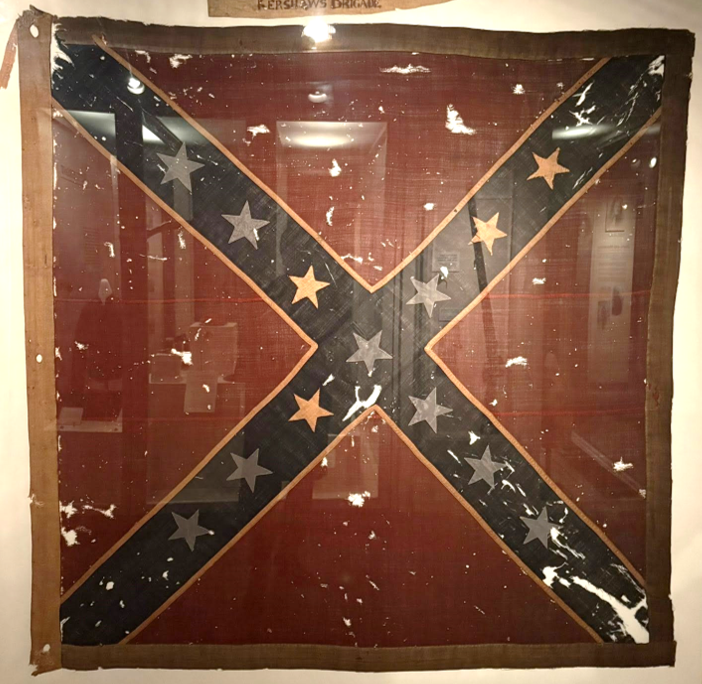
Third Pattern Richmond Depot Flag. Issued between October & November 1862 to replace the 1st Issue Battle flag, it would be carried by the regiment until mid-1863 when a new issue flag was received, and this flag was place in storage with the regimental baggage. After the capture of the Regimental Flag on October 19th, 1864, at Cedar Creek, this flag was brought out of the baggage after their return to Richmond, and was carried throughout the remainder of the War. Hidden away at the time of the surrender on April 26th, 1865, the flag was kept safe through the postwar years by Private Samuel Gaillard Pinkney of Company I, and would be used by the veterans of the regiment at reunion, parades, and was carried by 70 veterans of the regiment at the unveilings of the statue of General Robert E. Lee in Richmond, Virginia, on May 29th, 1890.

The flag measures 48 x 48 1/4 and is made of red, blue and white wool bunting, a white canvas hoist along the edge of the flag (to be attached to the staff) and with 13 white cotton five-pointed stars. It is now (2026) in the collection of the South Carolina Confederate Relic Room & Military Museum in Columbia, South Carolina.

(Left - Collection of the South Carolina Confederate Relic Room & Military Museum)


3rd Pattern Richmond Depot Battle Flag (With Battle Honors). Sometime between May and June 1863 the regiments of Kershaw's Brigade were issued new Third Patten Richmond Depot Battle flags which were adorned with Battle Honors for the actions in which they had participated. In the fighting at Cedar Creek, Virginia, on October 19th, 1864, the flag was captured by Colonel George Maltby Love (1831-1887) of the 116th New York Volunteer Infantry Regiment, who would later be awarded the Congressional Medal of Honor for his actions in capturing the flag. The flag was taken with other captured flags and trophies from the battle and deposited in the War Department on October 24th, 1864, and was assigned Capture No. 185. The flag remained in storage at the War Department in Washington, D.C., until sometime between 1865 and 1893 when the flag was loaned out to a group or person and was never returned, and it has not been seen since.

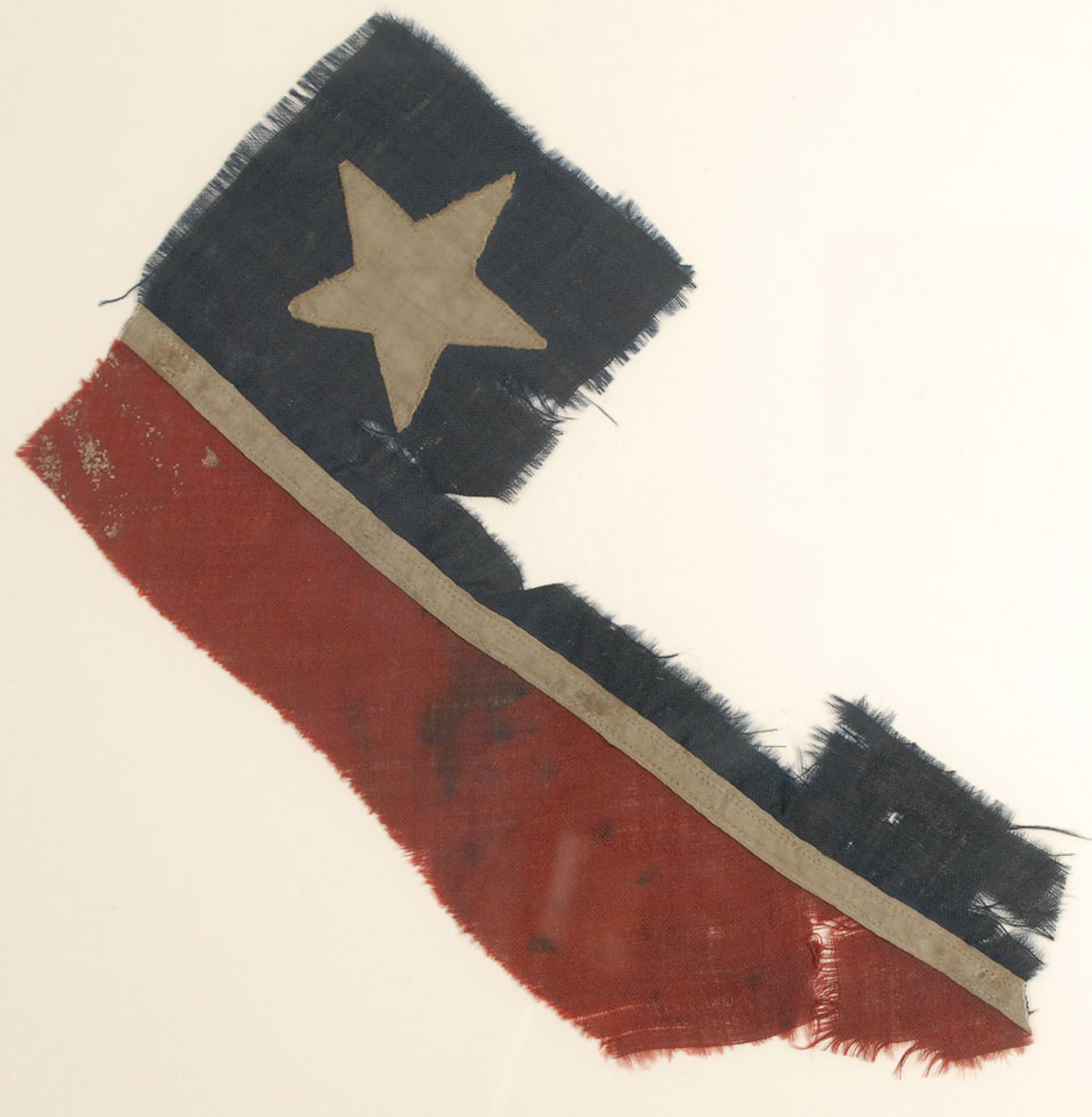
In November 1864 a section of the flag was cut out by Colonel Horace G. Thomas, Veteran Reserve Corps, at the request of Colonel Love, and presented to the Eagle Hose Company, Volunteer Fire Department, of Buffalo, New York, of which he was a member. This fragment was transferred and sold over the years and was last sold at auction in April 2014 by R.R. Auctions and is currently in a private collection. The fragment contains a portion of the red field, white piping and blue of the cross with one star, and the remnants of the stencil "LL" from the battle honor "MALVERN HILL."


(R.R. Auction)

With the fragments and the flags of the existing flags of the 3rd, 8th & 15th South Carolina Infantry Regiments we can roughly determine the flag measured roughly around 45x45 or 48x48, made of red, blue and white wool bunting, a white canvas hoist along the edge of the flag (to be attached to the staff) and with 13 white cotton five-pointed stars. The Battle honors were applied with white paint in stylized gothic letters, the only known battle is "Malvern Hill" from the lower section. However, it is safe to assume the honors would have matched those of the 3rd & 8th South Carolina's flag, being on the edges of the flag "Maryland Heights, Manassas Plain, Fredericksburg, Savage Station," with the inner circle being "Sharpsburg, Bull Run, Zoar Church, Malvern Hill"

 
  REFERENCES & RESOURCES

 
  • Published Books & Documents
  • "Broken Fortunes: South Carolina Soldiers, Sailors, & Citizens who died in the service of their country and the State in the War for Southern Independence, 1861-1865." Randolph W. Kirkland Jr., The South Carolina Historical Society, Charleston, South Carolina, 1995.

    "Compendium of the Confederate Armies. South Carolina and Georgia." Stewart Sifakis, Facts on File, Inc., New York City, New York, 1995.

    Volume V (South Carolina), "Confederate Military History." Clement A. Evans, Confederate Publishing Company, Atlanta, Georgia, 1899.

    "Confederate Rolls of South Carolina." Columbia, South Carolina, 1898.

    "The Flags of Civil War South Carolina." Glenn Dedmondt, Pelican Publishing Company, Gretna, Louisiana, 2000.

    "History of Kershaw's Brigade." David A. Dickert; Elbert H. Aull Company, Newberry, South Carolina; 1899.

    "Recollections and Reminiscences, 1861-1865, Thru World War I." South Carolina Division, United Daughters of the Confederacy; 1993.

    Volume I (1) - Page 383 (Colonel J.D. Kennedy)

    Volume II (2) - Pages 491 (J.L. Thornley), 493 (C.L. Hollingsworth of Co. I), 524 (P.W. Smith), 531 (T.L. Harris of Co. A) & 534 (J.H. Coleman of Co. A)

    Volume III (3) - Pages 64 (John M. Reynolds of Co. F), 227 (W.W. Purdy of Co. A), 228 (L.M. Moore of Co. B), 244 (C.O. Wheeler), 434 (Richard Kirkland), 443 (Butler Guard) & 523 (Roster of Company B)

    Volume V (5) - Pages 93 (Rhett Guard), 461 (Butler Guard), 467 (T.H. Dendy), 468 (G.A. Gibson of Co. A), 485 (Butler Guard) & 560 (Brook Guards)

    Volume VI (6) - Pages 29 (John R. Moore), 34 (J.T. Smith of Co. A), 49 (A.W. Blake of Co. F), 53 (H.G. Hartzog of Co. G), 247 (W.B.R. Gasque of Co. A), 265 (W.V. Allison) & 339 (C.O. Wheeler)

    Volume VII (7) - Pages 41 (A.B. Ellis), 43 (L.M. Moore of Co. B) & 169 (Company E)

    Volume VIII (8) - Pages 9 (J.H. Truesdale) & 287 (John M. Reynolds of Co. F)

    Volume IX (9) - Pages 7 (Company I) & 269 (J.Q. Croxton)

    "Report of the Historian of the Confederate Records to the General Assembly of South Carolina." John P. Thomas; The Bryan Printing Company, Columbia, South Carolina; 1900.

    Pages 111 to 132, Volume II (The Midlands), "South Carolina's Military Organizations During the War Between the States." Robert S. Seigler, The History Press, Charleston, South Carolina, 2008.

    "The War of the Rebellion: A Compilation of the Official Records of the Union and Confederate Armies." Government Printing Office, Washington, D.C., 1901.


  • Documents, Papers, & Non-Published Materials
  • Compiled Records of Confederate Soldiers who served in Organizations from the State of South Carolina. (M267, Rolls 153 - Second Infantry, A-B; 154, C-Dr; 155, Du-G; 156, H-K; 157, L-Mi; 158, Mo-P; 159, R-S; & 160, T-Z). The National Archives Microfilm Publications; Washington, D.C.

    Compiled Records Showing Service of Military Units in Confederate Organizations. (Roll 45 - South Carolina - First Infantry (Butler's) through Third State Troops). The National Archives Microfilm Publications; Washington, D.C.

     
    For copyright information see the Home Page of The Palmetto Riflemen & New York Zouaves; All rights reserved.
    No material is to be copied or reproduced without the written consent of the Webmaster.